

Part 1
The night they threw me and my daughter out of the house I had quietly paid for, the warm Atlanta air felt heavier than usual, as if even the city itself understood what had just happened.
“I gave you everything, and you gave my little girl tears,” I whispered as I stepped off the front porch, my daughter’s hand trembling inside mine.
They believed they were cutting away a useless branch from the family tree, removing the sister who was too tired, too quiet, too ordinary to belong in their polished world. What they never understood was that I had been the roots all along. I had been the unseen support beneath every luxury, every elegant dinner, every performance of wealth they wore like a second skin. When they told me never to come back, they had no idea they were telling the foundation to leave with me.
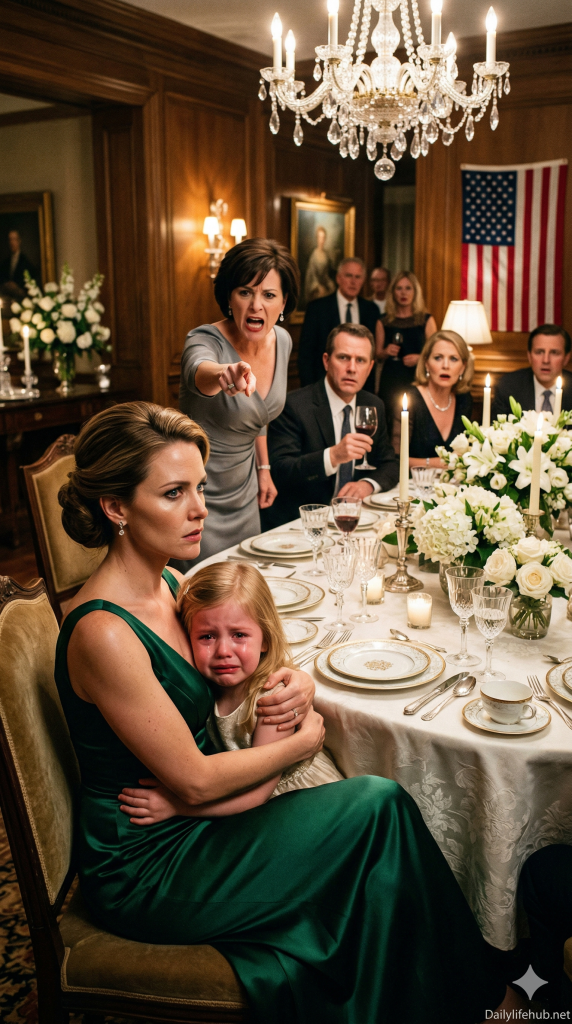
It had started as Easter dinner at the Whitmore estate in Buckhead, the kind of place people slowed their cars to admire from behind iron gates. The dining room looked like something from a magazine spread. The table gleamed beneath candlelight. Honey glazed ham filled the air with the sweet scent of maple and cloves. Crystal glasses sparkled beneath an extravagant chandelier, and a lush arrangement of white lilies stood in the center like a symbol of expensive perfection.

My sister, Celeste, sat in the spotlight she believed the world owed her. She wore cream silk that flowed over her body like water, a necklace of diamonds catching every turn of her head. She laughed often, mostly at things she said herself. Our mother, Eleanor, watched her with soft, glowing pride, the kind of tenderness I had spent my whole life trying and failing to earn.
I sat near the far end of the table, as though even in my childhood home I had become an afterthought. My shoulders still ached from a thirteen hour workday, and the exhaustion had sunk so deeply into my bones that even breathing felt like labor. Beside me sat my seven year old daughter, Emma, carefully cutting her food into tiny squares, trying to take up as little space as possible. She had already learned what children should never have to learn in a family home. Be quiet. Stay small. Do not invite cruelty.
Celeste lifted her wineglass and said, “I’m thinking of taking the convertible to Nantucket this summer. Atlanta is unbearable in July. Don’t you agree, Mother?”
Eleanor smiled with immediate approval. “That sounds lovely, darling. You have worked so hard on your image.”
“My brand, Mother,” Celeste corrected smoothly. “It’s called building a lifestyle platform.”
Then her eyes slid to me, and all that warmth vanished. “Adeline, could you try not to hover over Emma like that? You look nervous and worn out. It’s a holiday, not a funeral. Honestly, you’re draining the atmosphere.”
Under the table, Emma’s fingers curled around mine. “Mom, can we leave soon?” she whispered.
Before I could answer, Celeste laughed, bright and sharp as broken glass. “Actually, why don’t you just go now? You’ve barely spoken since you got here. You look exhausted, your dress looks cheap, and the whole sad single mother routine is ruining the mood. We’d like to enjoy dessert without feeling depressed.”
I waited for my mother to stop her. She never did.
Eleanor took a slow sip of wine and said, “She’s not wrong, Adeline. You have always had a way of making things feel heavier than they need to be. Celeste is trying to build something meaningful, and you just sit there looking burdened by life.”
The cruelty might have hurt less if it had not been wrapped in such effortless calm. To them, I was the struggling older daughter who worked some vague office job in the city and never quite recovered from being left by Emma’s father. They thought I was surviving, barely. They thought my silence came from weakness.
They did not know that every luxury in that room flowed from me.
They did not know that the Whitmore family trust they treated as an old inheritance was nothing more than an illusion I had preserved for years. They did not know that the money came from my company, Rowan Mercer Holdings, a property management and investment firm I had built from almost nothing. They did not know I had been the one paying the mortgage on the estate, covering the taxes, funding the cars, the cards, the utilities, the renovations, the landscaping, the household staff, and even the very flowers sitting between the candlesticks. I had let them believe my late father had secured their lifestyle because I could not bear to watch my mother face the truth about how close she had once come to losing everything.
For five years, I carried them without asking for gratitude.
For five years, I told myself I was doing it for family.
And for five years, they treated my daughter like she was lucky to be tolerated.
As I rose to clear Emma’s plate, my phone vibrated in the pocket of my dress. I glanced down and saw a private banking notification. Celeste had submitted another request through one of the linked family accounts. Twenty thousand dollars. Emergency travel allowance.
I looked up at my sister’s perfect face, at the woman who had just mocked my child and called my presence depressing, and something in me shifted. Not loudly. Not dramatically. Just completely.
The breaking point did not arrive like thunder. It arrived like a lock clicking open.
A moment later, Emma flinched when Celeste lunged across the table for her phone to take a photo. Her elbow caught a crystal vase near the centerpiece. It tipped, wobbled, then crashed to the floor in a dazzling explosion of glass.
The room fell silent.
Emma’s face drained of color. Her breath caught in her throat, and I saw terror flood her whole little body.
Celeste was on her feet instantly. “You careless child!” she snapped. “Do you know what you just destroyed? That vase was priceless.”
“I’m sorry,” Emma whispered, already crying. “I didn’t mean to.”
Eleanor did not look at the shattered glass. She looked at us.
Her expression was icy, final, and far crueler than rage. “I have had enough,” she said. “Enough of the mess, the sadness, the endless burden you bring into this house. You are a failure, Adeline, and you are raising your daughter to be one as well. All you ever bring into this family is stress, expense, and disappointment.”
“Expense?” I repeated, so quietly that even I barely heard it.
“Don’t start,” Celeste snapped. “You should be grateful we invited you at all. Look at you. You contribute nothing. Easter is better without you. Take your daughter and go. And do not come back for Christmas. Do not come back at all.”
Out of the family.
That was what they meant, even if Eleanor did not say the exact words.
I reached for Emma’s coat. My hands were steady. It surprised even me.
I did not beg. I did not remind them who had paid for the roof over their heads. I did not list every sacrifice, every sleepless night, every transfer, every lie I had told to protect their pride.
Instead, I looked at my mother and sister with the same calm I used in boardrooms when closing multimillion dollar deals.
“If I am such a burden,” I said, “then you will not mind losing everything that came with me.”
Celeste rolled her eyes. “Please. Just leave.”
So I did.
I walked Emma through the grand front hall, past the marble floors I had restored, past the custom art lighting I had approved, past the security console connected to systems billed through my company. The heavy front door closed behind us with a deep, echoing finality.
On the porch, Emma looked up at me with wet cheeks. “Are we in trouble, Mom?”
I crouched and held her face in my hands. “No, sweetheart. We are done being hurt.”
Then I pulled out my phone, opened a secure financial control app, and pressed the red authorization button I had designed years earlier for the day I prayed would never come.
Terminate all subsidiary family access.
Inside the house, they were still talking.
Outside, their countdown had already begun.
Part 2
Emma sat quietly in the back seat as I buckled her in, her small face still blotchy from crying. The estate glowed behind us, beautiful and false, every golden window lit by money they had never earned and never even thought to question.
“Are we going to be okay?” she asked.
I closed the car door gently and leaned in to kiss her forehead. “We are going to be more than okay. We are finally going to be free.”
I got into the driver’s seat but did not start the engine right away. Instead, I opened the control dashboard on my tablet and watched the shutdown sequence begin. Years earlier, when I first started funding my mother’s household through layered corporate structures and private accounts, my attorney had insisted on safeguards. I had built them all. Emergency cutoffs. Asset retrieval protocols. Occupancy termination clauses. Remote access removal. I never thought I would use them against my own family, but I had prepared anyway. Somewhere deep down, part of me must have known.
One by one, the systems began to obey.
Family credit access revoked.
Consulting stipends canceled.
Smart home registration removed.
Utility subsidies terminated.
Vehicle lease recovery initiated.
At first, nothing changed visibly. Then one of the upstairs windows flickered. A moment later, another dimmed. The heating and climate system, installed through a corporate testing program under my firm, began shutting down in stages. The dedicated internet line vanished. The gates switched to security lock mode. Their digital world, the one they mistook for inheritance, was disappearing in silence.
Inside the house, I saw movement. A shadow crossed one of the front windows fast enough to suggest panic. Then another. Celeste had probably tried her card first. It would have declined. She would have thought it was a glitch. Then she would have tried another. Then another. By then, Eleanor would have noticed the internet was down, the smart panel was flashing errors, and the front gates were no longer responding.
A black SUV turned into the drive behind me and rolled to a stop. On the side were the words Meridian Recovery Services. A man in a dark suit stepped out with a clipboard and a calm face that told me he had seen rich people lose everything before.
He had barely closed the car door when the front entrance burst open.
Celeste came running down the steps, the elegance stripped from her by panic. Her silk outfit whipped around her ankles as she hurried toward me with her phone in hand. “Adeline, what did you do? My cards stopped working. The internet is gone. The gates won’t open.”
Eleanor followed more slowly, but she looked worse. Pale. Disoriented. Smaller somehow. “Call someone,” she demanded. “This house is malfunctioning. The alarm is screaming, and the gates have locked. Fix it immediately.”
I lowered my window halfway and met her eyes. For once, I did not feel the old reflex to explain myself, defend myself, soften the truth so it would not embarrass her.
“I already fixed the problem,” I said.
Celeste stared at me. “What is that supposed to mean?”
“It means you told me to leave, and I respected your decision. Since my presence ruins your holiday, I assumed you would also want to be free of my money, my services, and my property.”
Their faces changed at the same time, confusion giving way to disbelief.
Eleanor frowned. “Your property?”
“Yes,” I said. “This house. The taxes. The insurance. The renovations. The utility accounts. The security systems. All of it. The trust you live off was never what you believed it was.”
Celeste let out a sharp laugh that sounded forced even to her own ears. “That is absurd. This house belonged to Grandmother.”
“No,” I said. “That was a story Mother kept alive because the truth embarrassed her. I bought this estate in a distressed sale five years ago. I let you live here without paying rent because I wanted Emma to have a grandmother. I covered every expense because I thought loyalty meant protecting family, even when family did not deserve it.”
The man from Meridian stepped forward at exactly the wrong moment for them and exactly the right moment for me.
“Excuse me,” he said professionally, glancing at the order in his hand. “Are you Ms. Celeste Whitmore? I am here to recover a leased Aston Martin registered under Rowan Mercer Holdings. I will also need access to the Mercedes sedan stored in the garage.”
Celeste looked as if she had been slapped. “Recover? That is my car.”
“It is a corporate lease,” he replied. “Payment authority has been revoked by the primary account holder.”
Eleanor turned toward me then, and for the first time in years, there was no superiority left in her face. Only fear. “Adeline,” she said, her voice breaking around my name, “this is too much. We were upset. Families say things. You do not destroy your own mother over a dinner argument.”
I almost laughed at the simplicity of that sentence. A dinner argument. As if cruelty repeated over decades could be reduced to one bad evening. As if the damage to Emma’s small heart did not matter because it happened beneath expensive lighting.
“You did not destroy me in one night either,” I said. “It took years.”
Celeste moved closer to my car, suddenly desperate. “Fine. We were harsh. But this is insane. Turn the accounts back on. Give us twenty four hours. At least unlock the gates.”
I looked past her toward the house, that monument to my silence and their entitlement. Then I looked at Emma in the rearview mirror, sitting so still, watching everything.
“No,” I said.
The word seemed to stun them more than any amount of yelling could have.
I continued, calm and precise. “The occupancy agreement is terminated. You have forty eight hours to vacate the premises before formal removal begins. Any personal items not listed in the protected inventory will be delivered to storage. The company legal team has already been notified. So has the sheriff’s office.”
Eleanor’s knees gave way beneath her, and she sank onto the gravel drive with a broken sound I had never heard from her before. Celeste turned pale enough that for a second I thought she might faint.
“How are we supposed to live?” my mother whispered.
The question might once have shattered me. Instead, it passed through me like air.
“The way I did,” I said. “By working.”
My phone rang. Local law enforcement, confirming the property status update and asking whether they should proceed if the occupants resisted the notice. I looked at my mother kneeling in the driveway and my sister standing beside her in total disbelief. Once, that image would have undone me.
Now all I felt was a clean, painful emptiness. Not hatred. Not triumph. Just the end of something rotten.
I answered the call with steady professionalism, confirmed the file, and ended it. Then I started the engine.
As I pulled away, Celeste pounded once on the trunk of my car and shouted my name, but I did not stop. In the back seat, Emma remained silent until the estate disappeared behind us.
Then she said, very softly, “You sounded strong.”
I swallowed hard.
“I should have sounded strong a long time ago,” I told her.
That night, in the apartment suite I kept under the company name for late workweeks downtown, Emma fell asleep tucked against my side with her hand resting on my sleeve as if she needed to make sure I was still there. I lay awake for hours, staring into the dark, listening to the strange quiet of a home that did not contain judgment.
I thought I would feel guilt. I thought I would feel grief. Instead, what I felt most was relief so deep it was almost frightening.
For years, I had mistaken endurance for love.
That night, I finally learned the difference.
Part 3
The collapse of their world was faster than even I expected.
Within two days, the illusion was gone. Without my firm feeding money into the accounts, the elegant life Eleanor and Celeste had performed for years turned out to be little more than carefully staged decay. The social calendar stopped. The cards were frozen. The cars were gone. The estate stood empty within the legal deadline, stripped of the identity they had borrowed and draped over themselves like royalty.
A month later, Emma and I were living in a bright three bedroom apartment high above downtown Atlanta, in a place filled with natural light and none of the emotional heaviness of my mother’s house. The rooms were simple, warm, and alive. Emma laughed more. She spread her crayons across the dining table without fear. She no longer froze at the sound of an adult voice rising in another room. I had not realized how much of her childhood had been shrinking until I watched her begin to take up space again.
One morning I sat in a sunlit café near the office while Emma sketched beside me in a new notebook. My phone buzzed with an update from the private investigator I had hired, not out of vengeance but because I needed to know whether either of them might try something reckless. The report was blunt. Eleanor and Celeste were living in a low cost motel on the outskirts of the city. Celeste had sold most of her designer wardrobe online for a fraction of its value. Eleanor had taken a part time library job in a neighboring county. The remaining trust structure had been dissolved legally and completely. There was no hidden fortune left, because there had never truly been one.
Attached to the report was a transcript from a recorded conversation in the motel room.
“Did she answer any of the emails?” Eleanor had asked.
“No,” Celeste replied. “She blocked everything. Even the lawyers will not call us back because we cannot pay them. It is over.”
Then there was a pause, followed by my mother’s confused voice saying the sentence that stayed with me long after I read it.
“I never understood how she did so much without saying anything.”
Celeste’s answer came back stripped of all glamour. “She was not weak. She was working.”
I set the phone down and stared out through the café window. For so many years, they had mistaken quiet for powerlessness because they only knew how to recognize noise. They thought worth had to be announced, displayed, photographed, applauded. They never understood the kind of strength that wakes before dawn, signs contracts, solves emergencies, holds a child through fevers, pays every bill, and still shows up to dinner only to be treated like a burden.
Emma looked up from her drawing and smiled at me. “Do you like it?”
I looked down. She had drawn a little apartment with yellow windows, a sun in the corner, and two figures standing side by side holding hands. Above us she had written one word in careful letters. Home.
That afternoon, another notification appeared on my screen. Celeste had been named in a local fraud and default dispute involving unpaid luxury lease obligations tied to social media sponsorship claims she could no longer support. I felt a brief pulse of pity, then let it go. Pity was not the same thing as responsibility. I deleted the alert and took Emma to the park.
By the following Easter, our life had built its own rhythm.
There was no grand mansion this time, no formal table set for appearances, no expensive flowers meant to impress people who never intended to stay. Instead, I hosted a small dinner in our apartment. Two of my closest friends came. My chief operations officer came with his husband. Emma painted eggs at the kitchen table and got color on her sleeves and laughed without checking whether anyone was annoyed.
The food was simple. The laughter was real. No one performed warmth. No one used affection as a hierarchy. No one treated my child as an inconvenience.
“Can this be our Easter every year?” Emma asked, holding up a hand painted egg as if it were treasure.
I smiled at her across the table. “Every year.”
Later that evening, after the guests had left and the apartment had gone quiet, I found an envelope slipped beneath my door. The handwriting on the front was shaky but familiar. It was from Eleanor.
I stood in the kitchen for a long time before opening it.
There was no request for money inside. No demand. No manipulative reminder of motherhood. Just three handwritten pages.
She wrote about the motel room, about the humiliation of learning how to stand in line for discounted groceries, about working late hours at the library and shelving books with aching hands. She wrote that pride had blinded her, that dependence had made her cruel, and that losing everything had finally forced her to see what I had carried for all those years. She admitted that she had treated my silence as weakness because it was easier than facing the truth that the daughter she dismissed had been the only adult in the room for years.
It was the closest thing to honesty I had ever received from her.
I did not cry. I did not forgive everything in a rush of sentiment. Some wounds are too old to close that neatly. But I also did not tear the letter apart.
Instead, I folded it carefully and placed it in a wooden drawer beside the window.
Not answered.
Not forgotten.
Just left there, waiting for whatever truth time might bring next.
Before bed, I checked one final alert on my phone. The Buckhead property had completed its transition into a women’s support residence through a charitable housing initiative funded by my company. The message confirmed new occupancy. Someone had unlocked the front door. Someone in real need was stepping inside a place that, for years, had sheltered arrogance instead of love.
I stood by the window and looked out at the city lights.
For most of my life, I had believed my role was to hold everyone up, no matter how badly they treated me. I thought love meant enduring humiliation, financing cruelty, and accepting whatever scraps of belonging were offered in return. But family is not defined by shared blood and polished portraits. Family is made of the people who protect your child, who soften your hardest days, who do not ask you to disappear so they can enjoy the room more fully.
I was no longer the invisible provider. I was no longer the quiet daughter at the end of the table.
I was simply Adeline.
And at last, that was enough.