

“Dad… I Didn’t Die” — The Morning a Wealthy Man Discovered the Truth Behind His Son’s Grave
The Boy Who Came Back from the Grave
Rain poured without pause the morning Julian Crestwood
parked his black car outside Greyhaven Cemetery.

He stayed inside longer than necessary, staring through the windshield, as if refusing to step out could delay the truth waiting beyond the gates—the place where his world had ended.
Six months earlier, everything had collapsed. The crash. The fire. The funeral.
His eight-year-old son, Leon, had been on a school bus that collided with a fuel truck. Officials said the blaze left no survivors.
Identification was rushed, documents stamped, conclusions finalized. Grief did the rest. Julian accepted what he was told because the alternative—hope—hurt too much.
Now he followed the familiar muddy path, red lilies clenched in his hand. He came here every week.
This grave was the last place where Leon still felt close enough to touch. With every step came memories—sticky laughter, endless curiosity, small fingers waving from a car window.
As Julian neared the headstone, something felt wrong. Someone was already there.
At first glance, he thought it was another visitor. Then he realized how small the figure was.
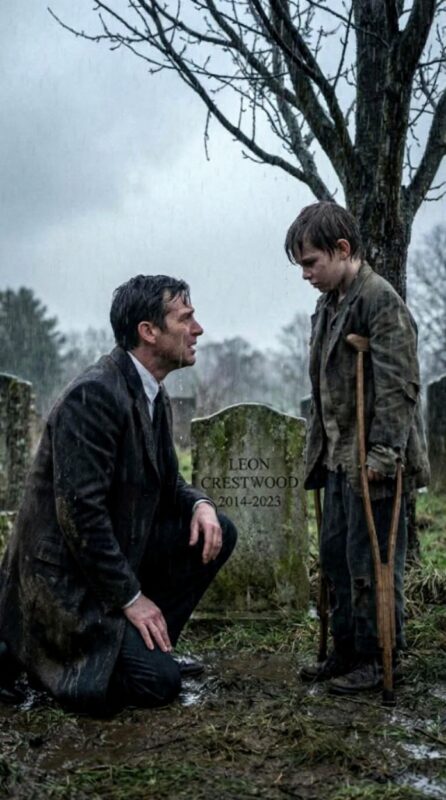
A boy stood near the grave, soaked through by rain, thin as a shadow. He leaned on a crude wooden crutch, his clothes worn and mismatched, his posture shaped by pain rather than play.
Julian stopped cold. The flowers fell from his hand.
The boy turned slowly. When their eyes met, Julian felt the air leave his lungs. There was no fear in the child’s gaze—only recognition, quiet and devastating.
The boy spoke, his voice rough and low. “Dad… it’s me. I didn’t die.”
The world seemed to split open. Julian’s mind snapped back to hospital corridors, sealed reports, the coffin sinking into the earth. The voice carried Leon’s cadence, but the face was thinner, marked by scars and loss.
“That’s not possible,” Julian whispered, shaking. “My son is buried here.” “I know,” the boy said. “I remember.” Panic surged. Julian stepped back. “Stop. You’re not him.”
The boy flinched, then murmured, “You always knocked twice before entering my room—so I wouldn’t be scared.” Julian’s legs buckled. No one else knew that.
Between ragged breaths, the boy explained. The crash. The flames. A broken leg. Smoke-filled lungs.
He woke in a hospital with no name and no memory, registered as an unidentified survivor. Paperwork failed him. Months passed in an institution until fragments returned.
“I remembered you,” he said. “And this place.”
Julian dropped to his knees in the mud, searching the boy’s face. Then he saw it—a small crescent-shaped birthmark near the left temple, the one he had kissed every night for eight years.
Julian shattered. He pulled the boy close, trembling. “You’re alive,” he sobbed. The miracle, however, exposed something darker.
DNA tests confirmed the truth. Investigations uncovered falsified records, rushed payouts, forged signatures.
Leon had been officially declared dead while still breathing in a hospital bed—erased for convenience, for profit.
Julian fought back. He sued. He spoke out.
The case exploded into a national scandal—a story not only of survival, but of a system that buried a living child while his father mourned an empty grave.
Later, the boy chose a new name—Noah—a name untouched by fire and lies. Julian rebuilt his life around patience instead of power.
And sometimes, they returned to Greyhaven Cemetery. Not to grieve.
But to remember what happens when humanity is replaced by paperwork.