

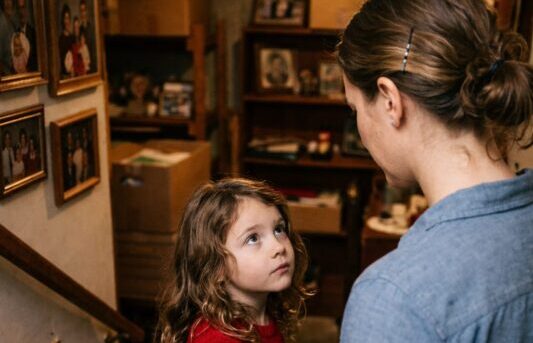
After Marrying a Widower with Two Daughters, One Day One of Them Took Me by the Hand and Led Me to the Basement to ‘See Mom’
When Daniel mentioned his daughters on our second date, I almost walked away.
“Grace is six, Emily is four. Their mom passed three years ago,” he said,
his voice carrying a weight I could feel. I reached for his hand and stayed.

The girls made it impossible not to. Grace brimmed with curiosity, while shy Emily slowly melted into my lap with a book.
A year later, we were married in a quiet ceremony by the lake. Daniel smiled often, but there was always a shadow of caution, like he didn’t trust happiness to last.
His home felt warm, alive, and full of memories—but one thing unsettled me: the basement door.
Always closed, always locked. Daniel insisted it was just storage, and I tried not to pry. Yet the girls’ strange behavior—hovering near it, then stepping away—made me uneasy.
One afternoon, when they were home sick and restless, everything changed. In the middle of their playful chaos, Grace tugged my sleeve, her eyes serious.
“Do you want to see Mom?” she asked. Emily added softly, “Mommy is downstairs.”
A chill ran through me. They led me to the basement door as though it were completely ordinary. Grace explained that their father sometimes took them there “when he misses her.”
My heart raced. The door was locked.
I should have waited—but instinct pushed me forward. My hands shook as I picked the lock with two hairpins while the girls watched silently. Click.
The door opened. The smell hit immediately: damp, sour, heavy with the weight of years.
The dim light revealed a room frozen in time: shelves of photo albums, framed pictures of Daniel’s late wife, children’s drawings, her cardigan draped on a chair, rain boots by the wall, and a small tea set on the table.
“This is where Mom lives,” Grace said quietly.
I looked closer and saw family videos stacked near the old TV—birthdays, trips, ordinary moments preserved. Emily clutched her rabbit tightly.
Then Daniel came home. He froze at the doorway. “What did you do?” he demanded, panic sharp in his voice.
“Step back,” I said gently, shielding the girls. Grace’s hand trembled. “Did I do something wrong?”
“No, baby,” he whispered, his voice breaking. I sent the girls upstairs and stayed behind.
“I didn’t know what to do,” he admitted. “After she died, I worked, I cared for them, but I couldn’t accept that she was gone.
I couldn’t let her things go… so we came down here sometimes, and it stayed this way.”
“You let them think she’s still here?” I asked softly.
“At first I didn’t realize it,” he said. “Then I didn’t know how to fix it without hurting them.”
“This isn’t healthy,” I said. He nodded, tears in his eyes. “I know.”
It wasn’t a secret crime—it was a shrine to grief.
The next day, Daniel spoke to the girls: “Mommy lives in your memories, in the stories we tell.” Grace asked if they could still watch her videos. “Of course,” he said.
A week later, the basement was organized, therapy numbers posted, the door unlocked. Life wasn’t perfect—but nothing had to be hidden anymore.
I stayed—not because it was easy, but because love sometimes means helping someone face the past.