

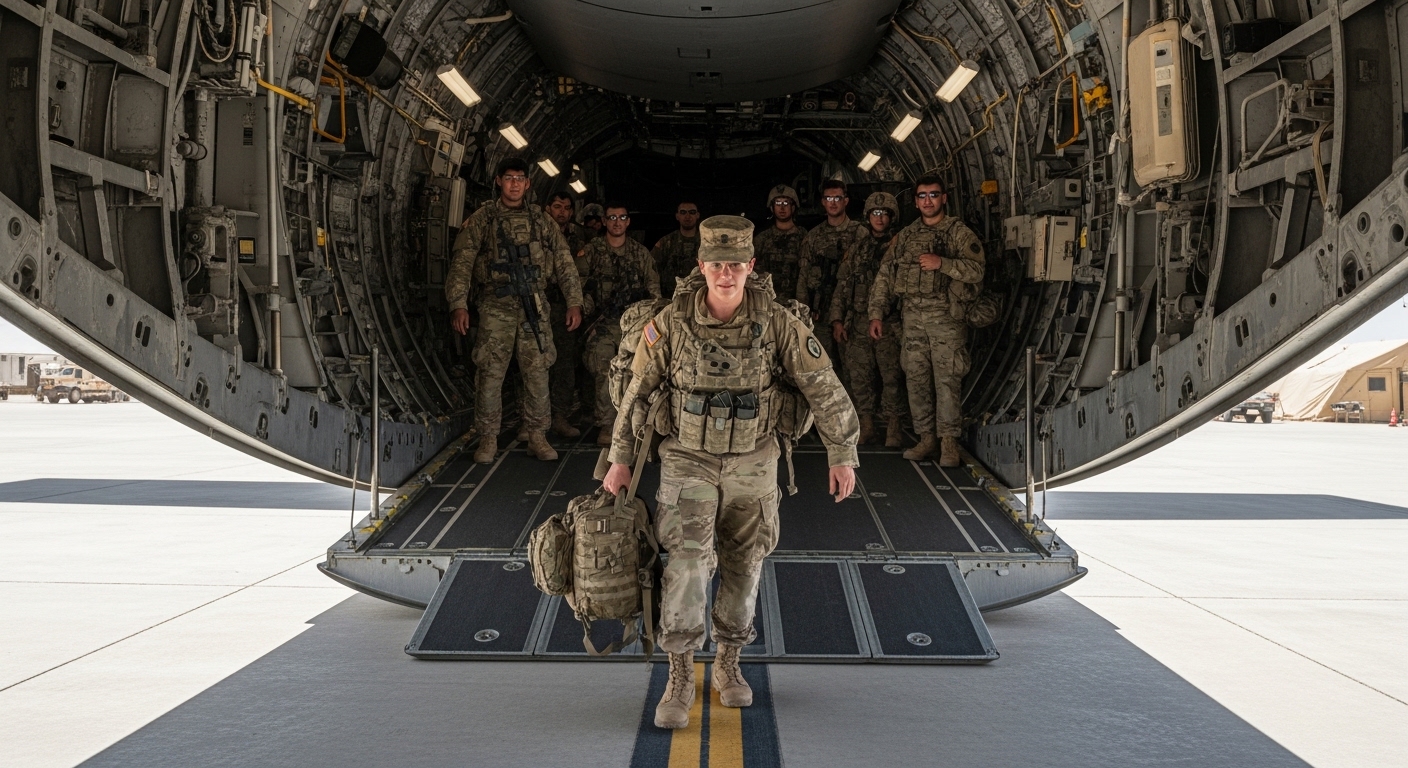
The ramp of the C-130 lowered, and the brutal heat of the Afghan summer hit me like a physical punch.
It wasn’t just the temperature. It was the smell. A suffocating mix of burning diesel, hot sand, and dried sweat.
I grabbed the straps of my rucksack, ignoring the searing pain in my lower back, and stepped out into the blinding sunlight of Forward Operating Base (FOB) Restrepo.
The dust was so thick I could taste it in my teeth.
I was exhausted. I hadn’t slept in seventy-two hours. My boots were heavy, my uniform was stiff with dried mud and worse things, and my eyes burned from the relentless glare.
But I didn’t have time to be tired. I had orders.
As I walked down the tarmac, dragging my ninety-pound bag, I could feel the eyes on me.
FOB Restrepo was an infantry stronghold. It was a place for door-kickers, grunts, and men who spent their days getting shot at in the surrounding valleys.
They were hard men. Tired men. Angry men.
And to them, I looked like an absolute joke.
I am five-foot-three. I weigh a hundred and twenty pounds soaking wet. My hair was pulled back into a messy, dust-covered bun, and my fatigues hung loosely on my small frame.
I didn’t look like a soldier to them. I looked like a lost high schooler who had wandered onto a battlefield.
I kept my head down and kept walking toward the command tent.
“Well, look what the wind blew in.”
The voice was loud. Mocking. It echoed across the staging area, cutting through the low hum of the generators.
I didn’t stop. I kept walking.
“Hey! I’m talking to you, sweetheart.”
A large shadow fell over me.
I stopped and looked up. Standing in my way was a Staff Sergeant. He was built like a linebacker, his face smeared with grease and sweat. His nametape read ‘MILLER’.
Behind him, a group of about ten infantrymen were lounging on some ammunition crates. They were all smirking.
“You lost?” Miller asked, spitting a stream of dark tobacco juice near my boots. “The admin tent is in the rear. With the air conditioning.”
“I’m heading to the command center, Sergeant,” I said quietly. My voice was raspy from the dust.
“Command center?” Miller laughed. It was a harsh, ugly sound.
The guys behind him chuckled along.
“Command doesn’t need any more typists today,” Miller said, taking a step closer. He towered over me. “And they definitely don’t need any little princesses getting in the way of a real war.”
Princess.
There it was. It wasn’t the first time I’d heard it. It wouldn’t be the last.
I took a deep breath. “Excuse me, Sergeant. I have orders to report directly to Colonel Vance.”
I tried to step around him.
Miller sidestepped, blocking me again. He crossed his massive arms over his chest.
“You don’t listen real well, do you, princess?” he growled. The amusement was gone from his voice. Now, he just sounded annoyed. “I said, the rear is that way. You don’t walk through my staging area.”
The tension in the air spiked.
The other soldiers stopped laughing. They sat up, watching to see what I would do. They expected me to shrink. To apologize. To turn around and find another way.
That’s what a normal junior enlisted soldier would do when confronted by an angry Staff Sergeant.
But I wasn’t normal. And I wasn’t junior enlisted.
My rank insignia was currently hidden beneath my tactical rig, and my unit patch—the one on my right shoulder—was covered by a layer of thick, gray Afghan dust.
“Sergeant,” I said, my voice dropping an octave. “Step aside.”
Miller’s eyes narrowed. “What did you just say to me, little girl?”
He stepped into my personal space. I could smell the stale coffee and tobacco on his breath. He was trying to use his size to intimidate me.
It was a tactic that probably worked on 99 percent of the people he met.
But for the past three years, I had been operating in places where intimidation wasn’t a game. It was a matter of life and death.
I stared straight up into his eyes. I didn’t blink. I didn’t shift my weight.
“I said, step aside.”
Miller’s face turned red. His ego couldn’t handle being defied by someone half his size in front of his squad.
“Listen here, you arrogant little—”
He reached out and shoved my shoulder. Hard.
It was meant to push me off balance. To knock me into the dirt so he and his boys could have a good laugh.
But my body didn’t react the way he expected.
Instincts took over. Training took over.
Before my brain even fully registered what was happening, my left hand snapped up, parrying his arm away with a sharp, violent crack. At the exact same moment, I pivoted my hips, dropping my center of gravity, and drove my right forearm straight up under his elbow.
The joint locked.
Miller let out a sharp gasp of pain and stumbled backward, completely losing his balance. He tripped over a fuel can and fell hard into the dirt in a cloud of dust.
Dead silence fell over the tarmac.
The other soldiers froze. Nobody breathed.
I stood exactly where I was, my posture relaxed but ready. I hadn’t even dropped my rucksack.
Miller scrambled to his feet. His face was purple with pure, unadulterated rage.
“You’re dead!” he roared, balling his fists and lunging toward me.
“STAND DOWN!”
The voice cracked like thunder across the base.
Miller stopped dead in his tracks.
I turned my head slightly.
Marching toward us with terrifying speed was Colonel Vance. He was the base commander. A legend in the division. A man known for ending careers with a single sentence.
He looked absolutely furious.
“What in the hell is going on here?!” Vance bellowed, storming up to us.
Miller immediately snapped to attention, though he was still breathing heavily, his eyes shooting daggers at me.
“Sir!” Miller barked. “This… this soldier assaulted a non-commissioned officer! She refused to follow directions and became physically hostile!”
Vance turned his furious gaze on me.
“Is that true?” he demanded. He looked me up and down, taking in my small size, my messy hair, my dusty uniform. I could see the disgust in his eyes. He hated indiscipline.
“Sir, the Sergeant placed his hands on me first. I simply redirected his movement,” I said evenly.
“Redirected?” Vance sneered. “You think you can come onto my base, start a brawl with my NCOs, and talk your way out of it?”
“No, sir. I—”
“I don’t care who you are or what desk you sit behind,” Vance interrupted, his voice echoing loudly so everyone could hear. “You are going to the brig. And then you are going on the next bird out of my province. Do you understand me?”
“Sir, I have orders—”
“I don’t give a damn about your orders!” Vance roared, stepping closer to me. “Who is your commanding officer? I want his name right now!”
As Vance leaned in to yell in my face, the heavy rotor wash from an incoming Blackhawk helicopter swept over the tarmac.
A massive gust of wind and sand blew over us.
I instinctively raised my arm to shield my face.
The wind blew hard, flapping my loose fatigue jacket. And as it did, the thick layer of gray dust that had been caked onto my right shoulder was blown away.
Vance was right in front of me. He was still glaring at me, his mouth open to yell again.
But the words never came out.
His eyes flicked down to my right shoulder. To the newly revealed patch.
It was a small, subdued black shield. There were no words on it. Just a specific, geometric insignia. A ghost patch.
I watched the transformation happen in real-time.
The deep red anger in Colonel Vance’s face vanished instantly.
All the color drained from his skin, leaving him looking sickly pale.
His jaw went slack. The furious fire in his eyes was replaced by something else entirely.
Shock. And genuine fear.
He stumbled backward a half-step, as if he had just been electrocuted.
“Sir?” Miller asked, looking confused by his commander’s sudden silence. “Should I call the MPs to take her away?”
Vance didn’t answer him. He couldn’t.
He was staring at my shoulder, swallowing hard. The imposing, terrifying base commander suddenly looked very, very small.
He slowly brought his eyes up to meet mine.
The silence stretched on for five agonizing seconds.
Then, Colonel Vance, a man with three decades of combat experience, slowly raised his hand… and snapped off a textbook, trembling salute to the ‘princess’ in the dirt.
“Ma’am,” he whispered.
CHAPTER 2
“Ma’am,” Colonel Vance whispered.
His hand was rigid, pressed against the brim of his patrol cap. His fingers were visibly trembling.
The silence on the tarmac was absolute. The only sound was the fading thud of the helicopter rotors in the distance.
Staff Sergeant Miller stood there, his jaw practically hitting the dirt. He looked from Vance to me, and then back to Vance. His brain was completely failing to process what he was seeing.
“Sir?” Miller stammered, the mocking bravado entirely gone from his voice. “Sir, with all due respect… what the hell are you doing?”
Vance didn’t look at him. His eyes remained locked on my face, completely ignoring the dust blowing around us.
“Staff Sergeant Miller,” Vance said. His voice was dangerously low. It lacked the booming fury from a moment ago, but it was infinitely more terrifying.
“Yes, sir?”
“You will stand at the position of attention,” Vance ordered, his voice cracking slightly. “And you will not speak another word until I explicitly order you to do so. Is that understood?”
Miller’s face flushed a deep, ugly crimson. Being dressed down in front of his squad was the ultimate humiliation for an infantry NCO.
But he knew better than to disobey a direct order from the base commander. He snapped his heels together, staring straight ahead. “Yes, sir.”
I kept my hands resting loosely by my sides. I didn’t return the Colonel’s salute.
Technically, in a combat zone, saluting officers in the open was strictly forbidden. It made them targets for snipers. Vance knew this.
The fact that he had done it anyway told me exactly how panicked he was.
“Drop your hand, Colonel,” I said quietly.
My voice didn’t carry past the three of us. It was flat and emotionless.
Vance immediately dropped his hand to his side. He swallowed hard again. A bead of sweat trickled down his temple, cutting a clean line through the dust on his face.
“I… I apologize, Ma’am,” Vance stuttered, his eyes darting to the blacked-out patch on my shoulder, then quickly away, as if looking at it would burn his retinas. “I was not informed that your… department… was operating in my sector.”
“That’s the point, Colonel,” I replied.
I finally reached down and grabbed the straps of my ninety-pound rucksack.
Before I could lift it, Vance lunged forward.
“Please, allow me,” he said, practically desperate to be helpful. The battle-hardened commander, a man who chewed up lieutenants for breakfast, was trying to carry my bags.
“I’ve got it,” I said, my tone shutting down his attempt instantly. I hoisted the heavy bag onto my shoulder. My spine screamed in protest, but my face showed nothing.
“Take me to a SCIF,” I ordered.
A SCIF is a Sensitive Compartmented Information Facility. A room completely secure from electronic eavesdropping, bugs, and unauthorized ears.
Vance nodded frantically. “Right away. Please, follow me.”
He turned and began power-walking toward the heavily fortified command center at the center of the base.
I followed right behind him.
As we walked, I could feel the eyes of Miller’s entire squad burning into my back.
The confusion was rapidly morphing into suspicion.
Infantrymen are a tight-knit brotherhood. They hate outsiders. And they absolutely despise intelligence operatives.
In their minds, “spooks” and “suits” only came to the front lines to do two things: steal the glory, or get grunts killed on suicide missions.
I heard one of the privates mutter loudly behind me. “Who the hell is she? An Inspector General? Did she catch the old man embezzling?”
“Shut up, idiot,” another voice hissed. “You see that patch? She’s an alphabet spook. CIA or worse.”
“She looks like a high schooler. Probably sleeping with a general,” a third voice whispered viciously.
They were trying to make sense of the impossible. They needed an explanation that fit their worldview. The idea that a five-foot-three woman could naturally command that level of fear from their Colonel was too much for them to swallow.
We reached the command center. It was a massive structure reinforced with thick concrete walls, surrounded by a double layer of HESCO sand barriers.
Two heavily armed sentries stood at the steel blast doors.
As Vance approached, they snapped to attention. They looked at me, their eyes narrowing with the same suspicion I’d seen on the tarmac.
“Open the door. Clear the tactical operations center,” Vance ordered sharply. “Everyone out. Now.”
The sentries exchanged a bewildered look. “Sir? The TOC is fully staffed. We have live feeds from—”
“Did I stutter, Corporal?!” Vance roared, his anger returning now that he was dealing with his own men. “I said clear the damn room! Everyone steps outside until I say otherwise!”
One of the sentries scrambled to open the heavy door, disappearing inside.
Ten seconds later, a stream of officers, intelligence analysts, and radio operators began pouring out of the building.
They looked annoyed and confused. They carried coffee mugs and clipboards, glaring at me as they filed past.
I was officially making enemies out of the entire base command staff. And I hadn’t even been here for fifteen minutes.
Once the room was empty, Vance ushered me inside and slammed the heavy steel door shut behind us.
He threw the heavy deadbolt. The heavy thud echoed in the sudden quiet.
The TOC was freezing cold. The air conditioning was cranked to the maximum to keep the massive banks of computers and servers from overheating.
The walls were covered in high-definition satellite maps, live drone feeds, and classified troop movement charts.
Vance walked over to the primary communications terminal. He leaned heavily against the desk, letting out a long, shaky breath.
“Okay,” he said, rubbing his face with both hands. “Okay. The room is secure.”
He turned to look at me. The fear was still there, but now it was mixed with a deep, weary resignation.
“I know what that patch means,” Vance said, his voice dropping to a harsh whisper. “I served in JSOC back in the early two-thousands. I’ve heard the rumors.”
“Rumors are just rumors, Colonel,” I said smoothly.
I dropped my heavy rucksack onto the floor. The impact made a loud thud.
I reached into my tactical vest and pulled out a solid black identification card. There was no photo. No name. No barcode. Just a single embedded gold chip.
I tossed it onto the desk in front of him. “Run it.”
Vance hesitated. He looked at the card like it was a live grenade.
Slowly, he picked it up and slid it into the secure military card reader attached to the main terminal.
The moment the chip made contact, the screen flashed bright red.
A loud, piercing warning tone echoed through the room.
WARNING. UNAUTHORIZED ACCESS ATTEMPT. LEVEL 8 CLEARANCE REQUIRED.
Vance stepped back, his eyes wide. “What the hell…”
Suddenly, the screen went completely black.
The cooling fans on the server tower roared to life, spinning at maximum capacity. Code began scrolling rapidly down the black screen, faster than the human eye could read.
Then, the screen flashed white.
A single line of text appeared in the center of the monitor.
IDENTITY CONFIRMED. OVERRIDE GRANTED. ALL COMMAND ASSETS TRANSFERRED.
Vance stared at the screen, utterly speechless.
My black card hadn’t just verified my identity. It had systematically bypassed his entire command structure and temporarily transferred complete operational control of FOB Restrepo to me.
“My God,” Vance breathed, staring at me. “You’re… you’re really one of them.”
“I need a vehicle, Colonel,” I said, ignoring his shock. “A heavily armored MRAP. Fully fueled. And I need the gate opened in exactly twenty minutes.”
Vance blinked, snapping out of his daze. “A vehicle? To go where?”
“Grid coordinate Alpha-Seven-Niner. The Korangal Valley.”
Vance’s face, which had just started to regain some color, went bone white again.
“The Korangal?” he gasped. “Ma’am, that’s impossible. That valley is swarming with Taliban fighters. It’s a total red zone.”
“I am aware of the threat matrix, Colonel.”
“No, you don’t understand,” Vance insisted, taking a step toward me. “We lost a five-man reconnaissance team out there yesterday. They vanished off the radar. No distress call. Nothing.”
He pointed a shaking finger at the map on the wall.
“We’ve been planning a massive, company-sized rescue operation for tomorrow morning,” he continued. “You can’t just drive out there alone. It’s suicide.”
“I am not asking for your permission, Vance,” I said coldly. “I am informing you of my itinerary.”
“I won’t allow it,” Vance said. He stood up straighter, trying to reclaim some of his authority. “I am responsible for every soul on this base. I don’t care what alphabet soup agency you work for. I am not sending a lone female operative into the deadliest valley in Afghanistan to get slaughtered.”
I stared at him for a long moment.
The silence stretched, heavy and oppressive.
“Colonel,” I said softly. “Do you remember Operation Red Dawn? Baghdad, 2003?”
Vance froze. The air seemed to leave his lungs.
“How… how do you know about that?” he whispered. “That operation was scrubbed from all official records.”
“I know that you hesitated to call in the airstrike on that compound,” I continued, my voice perfectly level. “I know that because you hesitated, three Rangers died. And I know that your commanding officer covered it up to save your career.”
Vance staggered backward until his back hit the wall. He looked like he was going to be sick.
“You’re going to give me the keys to that MRAP,” I said, taking a step closer to him. “And you are going to open that gate. Because if you don’t, I will make sure the ghosts of 2003 come back to haunt you very, very publicly.”
It was a bluff. I didn’t care about his past. I just needed the damn truck.
But it worked.
Vance slowly reached into his desk drawer and pulled out a set of heavy keys. He tossed them onto the table.
“May God have mercy on you,” he whispered.
“He usually doesn’t,” I replied, grabbing the keys and turning toward the door.
I unlocked the deadbolt and pulled the heavy steel door open.
The heat of the Afghan afternoon immediately rushed into the freezing room.
I stepped out of the TOC.
Waiting for me, blocking the path to the motor pool, was Staff Sergeant Miller.
He wasn’t alone. He had brought six men from his squad. They were fully kitted out in their combat gear, holding their M4 rifles across their chests.
Miller stepped forward. The furious red flush was gone from his face. Now, he just looked cold and dead-set on revenge.
“Hold up, princess,” Miller said, his hand resting aggressively on the pistol grip of his rifle.
“Step aside, Sergeant,” I said.
“The Colonel might be scared of whatever blackmail you have on him,” Miller spat, his eyes filled with absolute venom. “But we aren’t.”
He took another step closer. The six men behind him shifted their weight, subtly fanning out to block any escape route.
“We know your type,” Miller sneered. “You CIA spooks come down here, play your little spy games, get my brothers killed, and then hop on a chopper back to Washington.”
I didn’t say a word. I just watched his hands.
“You aren’t taking one of our trucks,” Miller declared. “You aren’t leaving this wire. You’re going to go sit in the admin tent until I figure out what the hell is actually going on.”
He reached out, attempting to physically grab my shoulder again.
Before his fingers could even brush my uniform, the deafening shriek of the base siren tore through the air.
WEEEE-OOOOO-WEEEE-OOOOO.
“INCOMING! INCOMING! INCOMING!” the automated voice blared over the loudspeakers.
Miller froze, his hand still suspended in the air.
For a fraction of a second, the veteran infantryman hesitated, caught entirely off guard by the sudden alarm.
I didn’t hesitate.
CHAPTER 3
The first mortar shell hit exactly seventy yards from where we stood.
The concussive shockwave was invisible, but it hit my chest like a physical wall of force.
A massive geyser of black earth, shattered concrete, and orange flame erupted into the blinding Afghan sky. The deafening crack temporarily wiped out all other sounds, leaving a high-pitched ringing in my ears.
Staff Sergeant Miller flinched.
It was a perfectly natural human reaction. Even a hardened combat veteran instinctively ducks when a hundred and twenty millimeters of high explosive detonates nearby.
He closed his eyes, raised his arms to shield his face, and dropped his weight.
I didn’t.
I had spent the last three years in a program that explicitly trained the human flinch response out of its operatives. When the explosion hit, my heart rate barely spiked.
I used his momentary blindness.
In a fraction of a second, I stepped inside his guard, hooked my boot behind his right heel, and delivered a sharp, open-handed strike to his chest plate.
Miller went down hard, his heavy gear slamming into the dust.
His men shouted in confusion, distracted by both the mortar strike and their squad leader suddenly hitting the deck.
I didn’t stick around to chat. I sprinted toward the motor pool.
“Get her!” Miller roared from the dirt, his voice barely audible over the base sirens. “Don’t let her take a truck!”
I was fast. Much faster than heavily armored infantrymen.
I reached the line of parked MRAPs—massive, fourteen-ton armored beasts designed to withstand landmines.
I hit the button on the massive steel door of the nearest vehicle, vaulted into the driver’s seat, and slammed the key Vance had given me into the ignition.
The heavy diesel engine roared to life with a deep, vibrating growl.
I reached to pull the heavy armored door shut.
Suddenly, a hand gripped the edge of the door, holding it open.
It was Miller. He was out of breath, a fresh cut bleeding down his cheek from his fall, his eyes wide with a mix of fury and adrenaline. Right behind him were two of his young privates, both looking terrified.
Before Miller could yell, a second mortar shell screamed through the air.
The whistle was terrifyingly loud. It was coming right at us.
“Incoming!” one of the privates shrieked.
Instinct took over for them. Instead of trying to pull me out, Miller and his two men dove headfirst into the back of my MRAP to escape the blast.
The mortar slammed into the motor pool’s fuel depot, fifty yards away.
The explosion was apocalyptic. A massive fireball rolled into the sky, and searing heat washed over the armored vehicle. Shrapnel rained down like lethal hail, pinging loudly against the MRAP’s thick hull.
I hit the electronic locking mechanism. The heavy steel doors slammed shut and bolted.
We were sealed inside.
“What the hell are you doing?!” Miller screamed, scrambling up from the steel floor. He unslung his M4 rifle and pointed it directly at the back of my head. “Shut off the engine! Now!”
“Put the safety on, Sergeant,” I said calmly, shifting the massive transmission into drive. “We have a schedule to keep.”
“I am not playing with you, spook!” Miller yelled, his voice cracking with panic and rage. “Shut it down or I will blow your head off!”
“No, you won’t,” I replied, never taking my eyes off the reinforced windshield.
I slammed my boot down on the accelerator.
The MRAP lurched forward, its massive tires tearing into the dirt.
“If you shoot me,” I continued, speaking over the roar of the engine, “fourteen tons of armor will crash into that concrete barrier at sixty miles an hour. And none of us are wearing seatbelts.”
Miller froze. He looked at the rapidly approaching perimeter wall.
“Brace yourselves,” I warned.
FOB Restrepo’s main gate was closed. Colonel Vance hadn’t opened it yet.
I didn’t have time to wait.
I aimed the reinforced front grill of the MRAP directly at the center of the heavy chain-link and steel-pipe gate.
“Are you insane?!” one of the privates screamed from the back.
We hit the gate doing fifty.
The sound of twisting, screaming metal was deafening. The gate buckled, snapped off its hinges, and flew violently out of the way.
We burst through the perimeter cloud of dust and barreled out onto the open dirt road.
“You just broke through a fortified checkpoint!” Miller yelled, stumbling as the vehicle bounced wildly over the uneven terrain. “They’re going to court-martial you! They’re going to shoot us!”
“Sit down, Sergeant,” I ordered. “And look at the screen.”
I pointed to the encrypted tactical display mounted to the right of the steering wheel.
Miller hesitated, then leaned forward, keeping his rifle raised.
On the black screen, a single, tiny green dot was blinking rapidly against a topographical map.
“What is that?” Miller demanded.
“That is a heavily encrypted emergency beacon,” I said smoothly. “It belongs to the five-man reconnaissance team that went missing yesterday.”
Miller’s breath hitched. The two privates behind him went completely silent.
Every man on the base knew about the missing team. They were brothers. The fact that they had vanished without a trace was a dark cloud hanging over the entire infantry division.
“They’re alive?” one of the privates asked, his voice trembling with a sudden surge of hope.
“For now,” I said. “The beacon just activated three minutes ago. It’s a manual distress signal. It means at least one of them is conscious, and they are in extreme, immediate danger.”
“Why didn’t command tell us?” Miller asked, his anger slowly giving way to profound confusion. “Why didn’t Vance scramble the QRF?”
“Because the beacon isn’t broadcasting on a military frequency,” I replied.
“Then what frequency is it on?”
“Mine.”
I took a sharp right turn, throwing the three men in the back against the steel bulkheads.
We were leaving the relatively safe plains and heading straight into the mouth of the Korangal Valley.
The Korangal was known as the “Valley of Death.” It was a jagged, claustrophobic nightmare of steep cliffs, dense timber, and deeply entrenched Taliban fighters.
“You’re taking us into the Korangal?” Miller gasped, staring out the reinforced glass at the looming mountains. “Just the four of us? In a single vehicle?”
“Yes.”
“That’s suicide!” Miller yelled, his panic returning full force. “We don’t have air support! We don’t have a convoy! They’re going to tear us to pieces before we make it a mile!”
“Check your weapons, Sergeant,” I said coldly. “Because we’re about to cross the phase line.”
The valley walls closed in around us immediately. The bright midday sun was blocked by the jagged peaks, casting the dirt road into deep, ominous shadows.
The silence inside the cabin was agonizing. The only sound was the deep hum of the engine and the harsh, heavy breathing of the three men in the back.
I kept my eyes scanning the ridgelines.
The tension was thick enough to choke on. Every boulder looked like a bomb. Every shadow looked like a sniper.
We drove for six terrifying miles.
According to the blinking green dot on the screen, the missing team was only a mile ahead, pinned down near a network of mountain caves.
“We’re actually going to make it,” one of the privates whispered, a nervous smile breaking across his dusty face.
That was his first mistake. You never say that in the Korangal.
The explosion happened a fraction of a second before the sound registered.
A massive, deeply buried Improvised Explosive Device (IED) detonated directly beneath our front right axle.
The force of the blast was catastrophic.
The entire right side of the fourteen-ton MRAP was lifted violently into the air. The world spun in a chaotic blur of brown and gray.
My head slammed hard against the reinforced side window. A flash of white light exploded behind my eyes, and the taste of copper flooded my mouth.
The heavy vehicle crashed back down onto its side with a bone-shattering crunch.
The engine screamed, choked, and instantly died.
The lights inside the cabin flickered and went out, plunging us into dim, dusty twilight.
For five seconds, there was absolute, ringing silence.
Then, the screaming started.
“Ahhhh! My leg! Oh God, my leg!”
I blinked away the blood dripping into my right eye and unbuckled my harness. I dropped awkwardly onto the side passenger door, which was now the floor.
I looked back.
The interior was a mess of tangled limbs, loose ammunition, and thick white smoke.
Miller was bleeding heavily from a gash on his forehead. One of the privates was pinned under a shifted ammunition crate, screaming in agony.
Before I could move to help him, the sharp, terrifying crack of a Rocket-Propelled Grenade (RPG) echoed through the valley.
BOOM.
The RPG slammed into the roof armor of the MRAP. The vehicle shook violently.
Then came the hail of bullets.
Hundreds of rounds of armor-piercing machine gun fire began hammering against the thick glass and steel hull. It sounded like being inside a metal drum during a hailstorm.
The Taliban had been waiting for us. It was a textbook, L-shaped ambush.
We were completely trapped.
“Return fire! Return fire!” Miller screamed, spitting blood.
He scrambled to the nearest gun port, shoved the barrel of his M4 through the slit, and began firing blindly into the tree line.
The uninjured private did the same, crying hysterically as he squeezed the trigger.
Their return fire was useless. We were shooting uphill at an invisible enemy, pinned down in a disabled metal box.
Another RPG slammed into the rear doors. The armor buckled inward, groaning under the immense pressure.
“The armor is failing!” Miller yelled, his eyes wide with raw, animal terror. He looked at me, his face a mask of furious despair. “You did this! You brought us here to die!”
The glass on the front windshield began to spiderweb under the relentless machine gun fire.
The white cracks spread like ice over a frozen lake. It was only a matter of seconds before the ballistic glass shattered completely, letting the bullets rip through the cabin.
We were fish in a barrel.
“Listen to me!” I shouted, my voice cutting through the deafening noise of the gunfire.
“Shut up!” Miller roared back. “You’re a dead woman! We’re all dead!”
He was panicking. His men were broken.
The situation had officially reached its absolute worst point.
The radar screen on my wrist began to beep rapidly.
I glanced down.
Dozens of red thermal signatures were moving down the slopes. The Taliban fighters were descending. They were coming to overrun the vehicle, take us prisoner, and execute us on camera.
“They’re coming down the hill!” the uninjured private screamed, dropping his empty magazine with shaking hands. “Sarge, they’re everywhere!”
Miller stopped shooting. He slumped against the steel wall, completely out of breath, blood pouring down his face.
He looked at his two young privates. He knew he had failed them.
“Fix bayonets,” Miller whispered, pulling a combat knife from his chest rig. His hands were shaking violently. “We don’t let them take us alive. You understand?”
The privates nodded, tears streaming through the dirt on their faces. They drew their knives.
They were preparing for the end. They were ready to die in the dirt of a forgotten valley.
I stood up straight, ignoring the throbbing pain in my skull.
I looked at the terrified infantrymen. I looked at the failing armor. I looked at the swarm of red dots moving toward us on my wrist display.
Then, I did something that made Miller stare at me like I had completely lost my mind.
I reached down and unbuckled my heavy tactical vest.
I let the heavy Kevlar plates drop to the floor.
I unclipped my standard-issue M4 rifle and tossed it aside.
“What… what are you doing?” Miller stammered, staring at me in total disbelief. “Are you surrendering?!”
I didn’t answer him.
I reached behind my back, beneath my uniform jacket, and gripped the cold, heavy steel of the item I had kept hidden from the moment I stepped off the helicopter.
I pulled it out.
It was a weapon. But it wasn’t military issue. It wasn’t something any standard soldier had ever seen.
It was completely matte black, violently angular, and pulsed with a faint, low-frequency blue light along its barrel.
The moment I brought it out, the air pressure inside the cabin dropped drastically. The hair on Miller’s arms stood straight up.
“What… what is that?” Miller whispered, dropping his combat knife.
I ignored him.
I reached up to the emergency release handle of the heavy roof hatch.
“Don’t open that!” Miller screamed, lunging to stop me. “They’ll shoot you to pieces!”
I turned to him, my eyes locking onto his terrified gaze.
For the first time since I arrived, I let the cold, professional mask slip.
“Sergeant,” I said, my voice eerily calm over the deafening sound of bullets hitting the hull. “I am not here to fight them.”
I gripped the handle.
“I am here to hunt.”
I pulled the release lever.
CHAPTER 4
The heavy steel lever clicked.
The hydraulic seals on the roof hatch hissed, and I shoved the heavy armored plate open.
The deafening roar of the L-shaped ambush instantly flooded the cabin. The sound of hundreds of armor-piercing rounds hammering against the MRAP’s hull was physically painful.
“Get back down here!” Miller screamed, his hands covered in his own blood. He lunged upward, trying to grab my combat boots to pull me back inside.
He missed.
I vaulted through the open hatch, pulling myself up onto the scorching hot, twisted metal roof of the disabled vehicle.
The bright Afghan sun blinded me for a fraction of a second. The air tasted like cordite, burning rubber, and pulverized rock.
Everyone thought I was throwing my life away. They thought I was committing suicide by stepping out of the only cover we had.
But nobody understood what was about to happen.
I dropped to one knee, keeping my profile as low as possible against the burning steel of the roof.
I raised the matte-black weapon to my shoulder. It didn’t have a standard optic. It synced directly to the tactical contact lens in my right eye.
A digital overlay immediately painted the mountainside in front of me.
Through the thick, choking smoke of the burning fuel depot, the thermal imaging highlighted twenty-four distinct red heat signatures hiding in the rocks above us.
They were Taliban fighters. They were pouring heavy machine-gun fire down onto our vehicle, laughing as they prepared to move in for the slaughter.
I squeezed the trigger.
There was no deafening bang. There was no muzzle flash.
The experimental magnetic-rail platform simply let out a low, sickening thwump.
A hyper-velocity, depleted-uranium flechette crossed the two-hundred-yard distance in less than a microsecond.
The Taliban machine gunner on the highest ridge instantly dropped. His weapon clattered down the rocks.
I didn’t pause to watch him fall. I shifted my aim.
Thwump. Thwump. Thwump.
Three more fighters fell backward, completely silent.
The Taliban wouldn’t stop firing at first. They were so deafened by their own weapons that they didn’t realize their men were dying.
But then, the fire began to slow.
Confusion rippled through their ranks. They were taking casualties, but they couldn’t hear the counter-fire. They couldn’t see any muzzle flashes from the MRAP.
Panic is a contagious disease on the battlefield. And I was the plague.
I slipped off the roof of the vehicle, dropping silently into the deep dust on the blind side of the road.
I left the safety of the armor behind and began moving rapidly up the steep, jagged scree of the mountainside.
I was flanking them.
I thought the climb would slow me down, but the adrenaline and the three years of black-site conditioning took over. My body moved like a machine.
A fighter popped up from behind a boulder just twenty feet to my right. He had an RPG loaded and aimed at the smoking MRAP.
Before his finger could brush the trigger, I fired from the hip.
The flechette took him perfectly in the chest plate. He collapsed instantly, the RPG spiraling harmlessly into the sky and detonating against the cliff wall.
The explosion sent a shower of rocks raining down.
The remaining fighters finally realized they were being hunted.
They abandoned their positions and began to fall back, scrambling higher up the mountain, desperate to escape the invisible ghost that was picking them off one by one.
I didn’t let them retreat. I pushed harder, my lungs burning, my boots slipping on the loose shale.
I followed the trail of dropped weapons and blood up toward the jagged peaks.
I crested a steep ridge and found myself staring at the gaping, black mouth of a natural cave system.
It was deeply hidden from aerial surveillance. This was their staging ground.
Two sentries stood at the entrance, frantically speaking into handheld radios, their eyes scanning the tree line below in pure terror.
I didn’t shoot them. The weapon’s battery was low, and I needed it for whatever was inside.
I holstered the rifle, drew my combat knife, and stepped out of the shadows.
The sentry on the left turned and saw me. A tiny, dust-covered woman holding a knife.
He opened his mouth to shout, but he never got the chance.
I closed the distance in three explosive steps. I parried his rifle barrel away, stepped inside his guard, and drove the blade upward.
The second sentry panicked. He lunged forward, swinging his AK-47 like a baseball bat.
I ducked under the heavy wooden stock, grabbed his tactical vest, and used his own momentum against him.
I pinned him hard against the jagged rock wall of the cave, knocking the breath completely out of his lungs, and finished the fight in total silence.
I stood alone at the entrance of the dark, freezing cave.
I wiped the blood from my face, drew my sidearm, and stepped into the absolute blackness.
The smell hit me first. A nauseating mixture of rust, unwashed bodies, and wet earth.
I switched my contact lens to night vision. The dark tunnel lit up in a grainy, neon green glow.
I moved silently down the winding corridor for almost a hundred yards.
Until I saw them.
At the back of a large, cavernous chamber, illuminated by a single, flickering battery-powered lantern, were five men.
They were American soldiers. The missing reconnaissance team.
They were stripped of their gear, covered in deep purple bruises, and chained heavily to the damp stone wall.
Two Taliban interrogators were standing over them. One was holding a camera. The other was holding a heavy steel pipe.
One of the American soldiers—a massive man with a bloody bandage wrapped around his head—was being violently dragged by his collar toward the center of the room.
They were preparing to film his execution.
Then I realized why the Taliban had fought so hard to defend this specific mountain. They weren’t just ambushing a patrol; they were protecting their high-value prizes.
I stepped out from behind the rock pillar.
I didn’t say a word. I just raised my sidearm.
Two suppressed shots echoed through the damp cavern. Pfft. Pfft.
Both interrogators dropped to the floor, dead before they even knew someone else was in the room.
The cavern fell into a stunned, breathless silence.
The five chained American soldiers stared at me. Their eyes were wide, bloodshot, and filled with complete disbelief.
Through the green glow of my night vision, I looked like a demon crawling out of the shadows.
I walked slowly across the stone floor toward the man they had dragged to the center.
He was breathing heavily, coughing up blood. He looked up at me.
It was Captain Hayes. The leader of the recon team.
“Who… who the hell are you?” Hayes rasped, his voice barely a whisper.
I holstered my pistol and pulled a heavy pair of bolt cutters from the small tactical pack on my back.
“I’m the princess,” I said softly.
I clamped the cutters onto the thick iron chain binding his wrists and squeezed. The metal snapped with a loud crack.
Hayes slumped forward, catching himself on his bruised hands. He stared at me, trying to process reality.
“You’re alone?” he coughed. “Command sent one little girl to pull us out?”
“Command didn’t send me, Captain,” I replied, moving to the next soldier and snapping his chains. “Command wrote you off as dead.”
I freed all five men. Two of them couldn’t stand on their own. They had broken legs and severe concussions.
“We can’t walk,” one of the young privates sobbed quietly, clutching his shattered femur. “Just leave us, Ma’am. Save yourself.”
“Shut up,” I snapped, my voice echoing off the cavern walls.
I grabbed the heavy straps of the private’s tactical harness.
I refused to let these men die in the dark.
“Captain Hayes, get your unwounded men to support the others,” I ordered. “I will take the point. We are moving.”
“We won’t make it,” Hayes said, leaning heavily against the rock wall. “The valley is crawling with them. There’s a whole battalion out there.”
“Not anymore,” I said coldly.
I walked back over to the dead interrogators, picked up one of their AK-47s, and racked the bolt.
“Stay behind me.”
The descent down the mountain was a nightmare.
The heat was oppressive. Every step was agony. I was carrying the heavy gear, holding the perimeter, and literally pulling the wounded private over the jagged rocks.
It took us forty-five agonizing minutes to reach the dirt road.
When we finally broke through the tree line, I saw the disabled MRAP.
It was smoking, riddled with bullet holes, and completely silent.
I thought Miller and his men were dead.
But as we stumbled out onto the road, the heavy rear doors of the MRAP suddenly groaned open.
Staff Sergeant Miller finally stood up from the wreckage.
His face was covered in a thick layer of blood and gray dust. His eyes were wide and haunted.
He looked at me. Then, he looked at the five battered, bleeding men I was guiding down the hill.
His jaw dropped. He dropped his rifle.
“Hayes?” Miller gasped, his voice cracking. “Oh my god… you found them. You actually found them.”
Miller and his two privates scrambled out of the smoking vehicle and rushed forward, throwing their shoulders under the wounded men, taking the weight off me.
Miller stopped and looked at me. The arrogant, mocking infantryman from the tarmac was entirely gone.
He saw the blood soaked into my uniform. He saw the cold, terrifying stillness in my eyes.
He didn’t see a princess anymore. He saw the apex predator of the valley.
“I… I’m sorry,” Miller whispered, his voice shaking with raw emotion and shame. “I didn’t know. I didn’t know what you were.”
“Secure the perimeter, Sergeant,” I said evenly. “The QRF is inbound.”
As if on cue, the heavy, rhythmic thumping of Apache attack helicopters filled the sky.
Three heavily armed gunships crested the mountain ridge, banking hard over the valley, their weapon systems locking onto any remaining heat signatures in the trees.
Behind them came the massive, twin-rotor Chinook extraction choppers.
We had survived.
Forty minutes later, we returned to FOB Restrepo.
The Chinook touched down on the same dusty tarmac where I had arrived just a few hours earlier.
The entire base was waiting. Word had spread.
Hundreds of soldiers lined the runway. They were completely silent.
The ramp lowered.
I walked out first.
My uniform was torn to shreds. My hands were covered in dried blood. My face was a mask of gray dust and soot.
Behind me, Miller and his men were carrying the wounded members of the missing recon team.
The medical teams rushed forward, swarming the stretchers, shouting orders and administering IVs.
The crowd of hardened infantrymen parted like the Red Sea as I walked down the ramp.
The men who had laughed at me, the men who had mocked my size, the men who had called me “princess”—they all stood at rigid attention.
Nobody spoke. They just stared in absolute, reverent awe.
Standing at the very front of the crowd was Colonel Vance.
He looked ten years older. His face was pale, his hands were shaking, and there were actual tears welling in his fierce eyes.
He wasn’t looking at me. He was looking past me, at the medical stretchers.
He saw Captain Hayes sitting up, holding a bloody bandage to his head.
Vance let out a choked, desperate sob. He broke every rule of military decorum, sprinting across the tarmac and dropping to his knees beside Hayes’ stretcher.
He grabbed the younger man’s hand and buried his face in his chest, weeping openly in front of his entire division.
Then I realized why Vance had been so terrified to authorize a rescue mission.
Captain Hayes wasn’t just a squad leader.
He was Colonel Vance’s only son.
Vance had been paralyzed by the terrifying political and emotional weight of sending his own men to die to save his own boy. He had frozen.
I hadn’t.
I was hiding my identity, yes. But more importantly, I was protecting the very soul of this base.
Vance slowly stood up from his son’s stretcher. He wiped his face, turning to look at me.
He walked slowly across the tarmac until he was standing exactly where we had met hours before.
He looked at my small frame. He looked at the heavy, classified weapon slung across my back.
He looked at the blacked-out ghost patch on my shoulder, now completely visible, stripped of all the dust and dirt.
He finally understood what was underneath the uniform.
It wasn’t a soldier. It was an absolute force of nature.
Colonel Vance snapped his heels together.
In front of a thousand silent men, the highest-ranking officer in the province raised a trembling hand and rendered a slow, perfect, and deeply emotional salute.
I stopped walking.
I looked at him. I looked at the hundreds of men saluting behind him.
I didn’t smile. I didn’t gloat.
I simply raised my blood-stained hand, returned the salute, and walked away into the dust.