

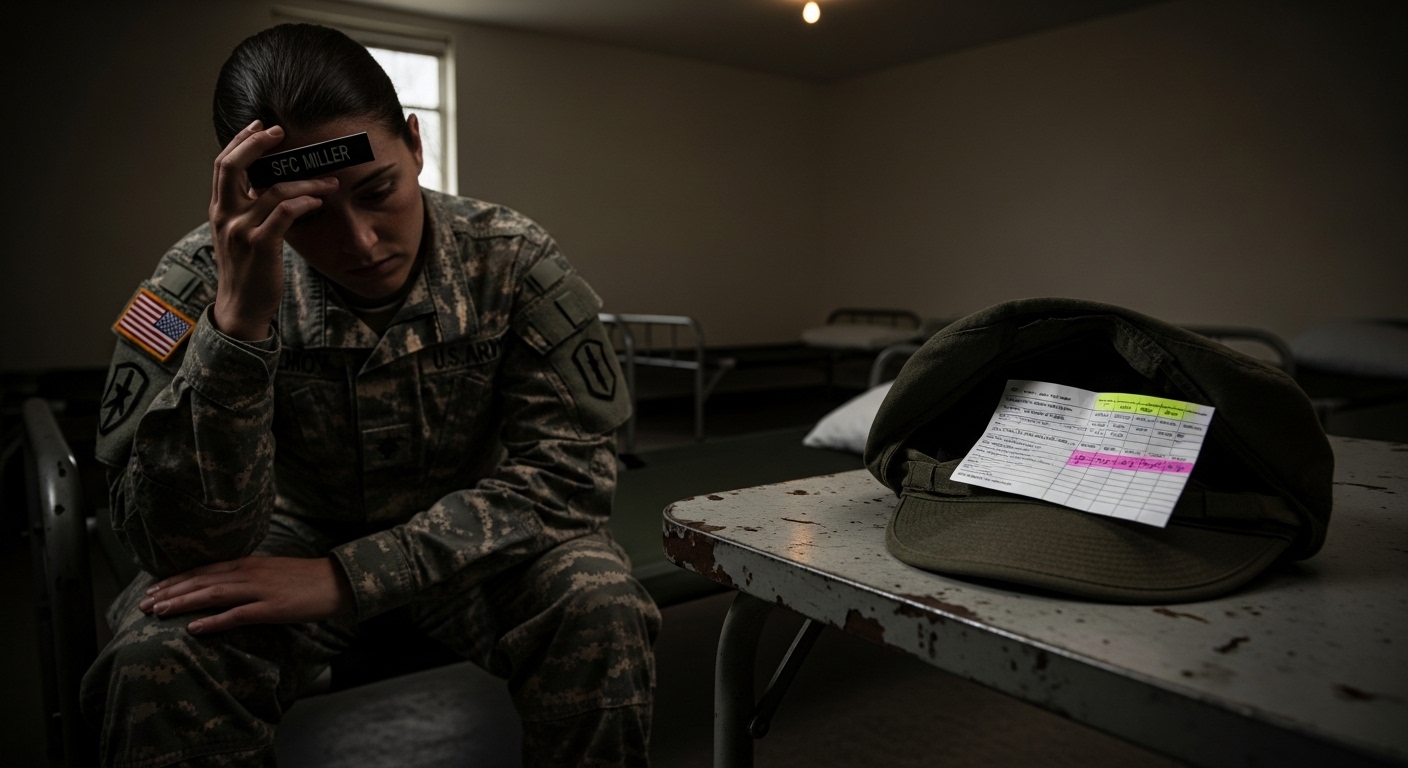
FULL STORY: CHAPTER 1
The humidity in Kentucky during the late summer doesn’t just sit on you; it swallows you. It was 05:30, and the air around the 101st Airborne Division barracks felt like a damp wool blanket. I was laced into my boots, the rhythm of the laces snapping against the leather a familiar comfort.
My name is Maya Rodriguez. To the Army, I was Specialist Rodriguez, a logistics clerk with a knack for finding missing inventory that others had written off as “lost in transit.” To my father back in Chicago, I was the daughter who made it—the one who wore the flag on her shoulder and carried the family’s pride in her ruck.
I loved the Army. I loved the structure, the way everything had a place, and the way a person’s worth was measured by the shine on their brass and the reliability of their word.
Or at least, that’s what I believed until I met Sergeant First Class Elias Thorne.
Thorne was the kind of NCO who looked like he’d been carved out of a piece of old oak. He was forty, lean, with eyes the color of a winter Atlantic—cold, grey, and impossible to read. He had a way of leaning against the doorframe of the supply office that made the room feel smaller, more suffocating. He was charismatic, the kind of guy who could charm a General and then smoke a Private until they puked, all with the same easy smile.
But I’d seen the way his eyes lingered on the inventory sheets. I’d seen the way he handled the “sensitive items” manifests.
“Rodriguez,” Thorne’s voice drifted through the motor pool that morning. It wasn’t a shout; it was a low, melodic drawl that always made the hair on my neck stand up.
“Yes, Sergeant First Class?” I stepped out from behind a humvee, wiping grease from my hands with a rag.
He was standing there, silhouetted by the rising sun, a clipboard tucked under his arm. “We’ve got a special shipment coming in. Night vision optics. High-end stuff. I need you to bypass the standard intake and move them directly to Storage Locker 4-B. I’ll handle the digital logging myself later. We’re on a tight turnaround for the field exercise.”
I paused. My training screamed at me. “Sergeant, regulation says everything has to be logged into the system the moment it hits the bay. I can’t move sensitive items without a paper trail.”
Thorne took a step closer. He didn’t get angry. He did something worse—he acted disappointed. Like a father whose favorite child had just failed a basic test.
“Maya,” he said, using my first name—a subtle violation of protocol that always felt like a threat dressed as an endearment. “I’m the Platoon Sergeant. I’m telling you that the Colonel needs these units ready for the 09:00 briefing. Are you telling me you’d rather follow a piece of paper than support the mission?”
“No, Sergeant. But—”
“No ‘buts.’ Move the crates. I’ll take the heat if anyone asks. Consider it a direct order.”
In the military, a direct order is the ultimate trump card. You’re taught to obey first and question later, especially when the person giving the order has fifteen years of service and three combat tours. I was a Specialist. He was a God in our small world.
I moved the crates.
I spent the next two hours hauling heavy, olive-drab cases into the shadows of Storage Locker 4-B. It was a secluded spot, rarely used, located at the far end of the compound where the security cameras were notoriously “glitchy.” I felt a knot of dread tightening in my stomach with every crate I stacked.
As I turned to lock the door, Thorne appeared again. He looked at the crates, then at me.
“Good work, Rodriguez. Now, why don’t you take an early lunch? You’ve been working hard. I’ll finish up the paperwork. Go on, get out of here.”
I wanted to believe him. I wanted to believe he was just a hard-charging NCO trying to cut through red tape. I headed to the chow hall, but I couldn’t eat. The knot in my stomach had turned into a lead weight.
I sat with PFC Sarah Jenkins, my bunkmate and the only person I really trusted. Sarah was a tech-head, a girl from Seattle who could rebuild a radio in her sleep but struggled with the physical demands of the “Rakkasans.”
“You look like you’re waiting for a ghost,” Sarah said, poking at her mystery meat.
“Thorne had me move the new NVGs to 4-B,” I whispered, glancing around to make sure no one was listening. “Off the books. He said he’d log them later.”
Sarah stopped eating. Her eyes widened behind her glasses. “Maya, that’s a breach of SOP. If those things go missing, your name is the last one on the digital signature for the truck delivery.”
“He gave me a direct order, Sarah. What was I supposed to do?”
“You should have recorded him,” she muttered. “That man is a snake. My cousin was in his last unit at Fort Hood. She said equipment used to ‘vanish’ all the time, but Thorne always had a fall guy. Usually a junior enlisted who didn’t know better.”
A chill ran down my spine. “I need to go back. I need to make sure he logged them.”
I didn’t finish my lunch. I ran back to the motor pool, my boots pounding against the hot asphalt. When I reached the supply office, it was empty. I jumped onto the computer and pulled up the inventory system.
Nothing.
The shipment of thirty-two night vision units—valued at over a hundred thousand dollars—wasn’t there. According to the system, the truck had arrived, but the items had never been “received” into our inventory. On paper, they had vanished into thin air the moment they left the tailgate of the delivery truck.
And I was the one who had signed the driver’s manifest.
“Looking for something, Specialist?”
I jumped, nearly knocking the monitor off the desk. Thorne was standing in the doorway, his arms crossed. But he wasn’t alone. Standing behind him were two Military Policemen and our Company Commander, Captain Miller.
Captain Miller looked at me with a mixture of shock and disgust. “Specialist Rodriguez, step away from the computer.”
“Sir, I was just—”
“We received an anonymous tip,” Thorne said, his voice dripping with faux-sorrow. “Someone reported seeing a junior enlisted soldier moving sensitive items into an unauthorized storage locker after hours. I didn’t want to believe it was you, Rodriguez. I really didn’t.”
My jaw dropped. “What? Sergeant, you ordered me to move them! You told me to put them in 4-B!”
Thorne looked at the Captain and shook his head. “Sir, I was in the mess hall for the last two hours. I have five witnesses who saw me there. I haven’t spoken to Rodriguez since the morning formation.”
“That’s a lie!” I screamed, the panic finally boiling over. “Sir, he told me to bypass the log! He said the Colonel needed them!”
Captain Miller stepped forward. “The Colonel is on leave, Rodriguez. There is no briefing. We just checked Locker 4-B. It’s empty. The crates are gone.”
The world tilted on its axis. Empty? I had just put them there. I had locked the door.
“Search her locker,” Thorne suggested quietly. “If she’s moving that much hardware, she might have the keys or a manifest.”
The MPs didn’t wait. They marched me to the barracks. I felt like a criminal, led through the halls where my fellow soldiers watched in stunned silence. They tossed my room. They ripped the sheets off my bed and threw my belongings onto the floor.
And then, one of the MPs reached into the pocket of my spare ACU jacket hanging in the wall locker.
He pulled out a small, high-capacity flash drive and a set of keys with a “4-B” tag.
“I’ve never seen those before!” I gasped, my voice cracking. “I swear, I don’t know how those got there!”
Captain Miller took the flash drive, his face hardening. “This is a serious offense, Rodriguez. Theft of government property, conspiracy, and making false statements against a superior officer. You’re being placed under pre-trial confinement.”
As the MPs grabbed my arms, I looked at Thorne. He was standing in the hallway, just out of the Captain’s line of sight. He wasn’t looking at me with anger.
He was smiling.
It was a tiny, cruel twist of the lips. It was the look of a man who had played a game a hundred times and had just won again. He had used my own loyalty against me. He had used the “direct order” to make me his accomplice, then wiped the tracks and planted the evidence to make me the culprit.
I was twenty-four years old. I had a 4.0 GPA in high school. I had never even had a speeding ticket. And now, I was being dragged out of the barracks in handcuffs, facing ten years in Leavenworth.
“Wait!” Sarah Jenkins shouted, running out of her room. “Sir, you can’t just take her! She didn’t do this!”
“Back off, PFC,” Thorne barked, his voice regaining its command authority. “Unless you want to be investigated for conspiracy too.”
Sarah froze. She looked at me, her eyes filled with tears and terror. I shook my head, silently telling her to stay back. There was no point in both of us drowning.
As they pushed me into the back of the MP cruiser, I saw Thorne leaning against the brick wall of the barracks. He pulled out a cigarette and lit it, the smoke curling around his head like a crown. He looked like the king of the world.
He thought he’d covered everything. He thought that because I was young and female and “just a Specialist,” I would be an easy sacrifice. He thought that by planting those keys in my locker, he’d closed the case.
But what Thorne didn’t know was that I wasn’t the only one he had underestimated.
He didn’t know about the small, cracked mirror in the corner of the motor pool. He didn’t know about the old Staff Sergeant who spent his nights cleaning the floors because he couldn’t sleep from the memories of war. And most of all, he didn’t know that even the most perfect plan has a footprint.
I sat in the back of that car, the metal cold against my wrists, and I didn’t cry. The fear was gone, replaced by a cold, burning white light of rage.
He wanted a war? Fine. He had no idea who he was fighting.
CHAPTER 2
The silence of a military brig isn’t really silence. It’s a heavy, pressurized hum—the sound of fluorescent lights buzzing against concrete, the distant clank of a heavy steel door, and the rhythmic, mocking pace of a guard’s boots in the hallway.
I sat on the edge of my cot, my hands clasped so tightly my knuckles were white. I was still wearing my ACUs, but they had stripped me of my belt, my bootlaces, and my pride. Without the laces, my boots felt like lead weights, floppy and useless, much like I felt. Every time I closed my eyes, I saw Thorne’s smile. That tiny, microscopic curve of his lips as the MPs led me away. It was the smile of a man who had not only committed a crime but had successfully outsourced the punishment for it.
The charges were staggering. Larceny of government property, false official statements, and conduct unbecoming. In the civilian world, “larceny” sounds like a lawyer’s word. In the Army, it sounds like a death sentence.
“Specialist Rodriguez?”
The voice was sharp, cutting through my spiraling thoughts. I looked up. Standing behind the bars was a man in Class B blues. He was lean, with a face that looked like it had been weathered by too many long nights and too much bad coffee. His nameplate read VANCE.
“I’m Captain David Vance,” he said, his voice devoid of the usual military bark. It was tired, clinical. “I’ve been assigned as your TDS—Trial Defense Service counsel. Can we talk, or are you still in shock?”
I stood up, my boots sliding awkwardly. “Sir, I didn’t do it. Sergeant First Class Thorne ordered me—”
“Stop,” Vance interrupted, raising a hand. He signaled the guard to open the cell. He stepped inside and sat on the only other piece of furniture—a bolted-down metal stool. He opened a manila folder. “Everyone in here didn’t do it, Rodriguez. My job isn’t to believe you. My job is to look at the evidence. And right now? The evidence is a goddamn mountain, and you’re standing at the bottom of it with a plastic shovel.”
He began laying out photos on the cot. “Thirty-two AN/PVS-14 night vision monoculars. Missing. Estimated value: $128,000. Your digital signature on the delivery manifest. A set of keys to Storage Locker 4-B found in your locker. A flash drive containing a modified inventory log, also found in your locker. And finally, five—count ‘em, five—sworn statements from NCOs and officers placing SFC Thorne at the dining facility at the exact time you claim he was giving you illegal orders.”
I felt the air leave my lungs. “He planned it. He knew exactly when he’d be seen at the DFAC. He must have moved the crates while I was at lunch.”
Vance leaned back, rubbing his eyes. “Maybe. But Thorne is a hero, Maya. Two Silver Stars. A Purple Heart from Fallujah. He’s the Brigade Commander’s go-to guy. You’re a Specialist with two years of service. To a jury of officers and senior NCOs, you look like a kid who got greedy and tried to pin it on the legend who caught her.”
“I have a witness,” I whispered. “PFC Sarah Jenkins. She saw me after the delivery. I told her what Thorne said.”
Vance sighed, a long, weary sound. “I talked to Private Jenkins an hour ago. She’s terrified, Rodriguez. She says she remembers you being stressed, but she ‘doesn’t recall’ the specifics of what you said about Thorne. She’s worried about her own career. Thorne has been ‘counseling’ the whole platoon since your arrest. He’s reminding everyone that loyalty goes up and down the chain, and anyone siding with a ‘thief’ is just as guilty.”
I sat back down on the cot, the cold metal seeping through my trousers. I thought of my father. I thought of the way he’d stood on the porch when the recruiter first came by, his chest puffed out with a mixture of fear and immense pride. “My daughter is going to be a soldier,” he’d told the neighbors. “She’s going to be the best of us.”
If I went down for this, it wouldn’t just be my life that ended. It would break him. He believed in the Army the way some people believed in God. He believed the system was inherently just.
“I need a way out, Sir,” I said, my voice cracking for the first time. “I didn’t join the Army to steal optics. I joined to be like the people I saw in the history books. I’m not a thief.”
Vance looked at me for a long moment. For the first time, the clinical mask slipped, and I saw a flicker of something—maybe empathy, or maybe just a shared hatred for bullies.
“Thorne is smart,” Vance said quietly. “But men like him have a weakness. They’re arrogant. They think they’ve accounted for every variable because they think they’re the only ones playing the game. If he’s as clean as the file says, then he’s been doing this for a long time. And if he’s been doing it for a long time, he’s gotten sloppy somewhere. He’s comfortable.”
“Where do we start?”
“We don’t,” Vance said, standing up. “I start by filing motions. You start by staying alive in here and keeping your mouth shut. Don’t talk to the guards. Don’t talk to the other inmates. Thorne will have ears everywhere. If you remember anything—anything at all, no matter how small—you tell me.”
He turned to leave, but stopped at the door. “By the way, Rodriguez. Why did he pick 4-B? That locker is half-condemned. The roof leaks, and the lock is an old-school manual tumbler, not the electronic ones used for sensitive items.”
“I don’t know,” I said. “He said it was because it was ‘out of the way’ for the field exercise.”
Vance nodded thoughtfully. “Out of the way. Yeah. Also out of the line of sight for the main security hub. I’ll be in touch.”
The next three days were a blur of grey walls and tasteless food. I spent every waking second replaying the morning of the theft in my head. I walked through the motor pool in my mind, step by step. I saw the truck pull in. I saw the driver—a civilian contractor with a neck tattoo. I saw the crates. I saw the way Thorne had stood by the door.
Wait.
I closed my eyes and focused on that image. Thorne by the door. He’d been holding a clipboard, but he hadn’t been writing. He’d been looking at his watch. Not his wrist—his phone. He’d tapped it three times, then nodded.
Was he signaling someone?
On the fourth day, I was pulled out of my cell. I expected Vance, but instead, I was led to the visitors’ room. Sitting behind the plexiglass wasn’t my lawyer.
It was Staff Sergeant Silas Miller.
Everyone called him “Pop.” He was a fifty-five-year-old motor pool mechanic who had been at Fort Campbell since before I was born. He was a “homesteaded” soldier—the kind the Army kept around because he knew where every pipe, wire, and secret was buried in the base infrastructure. He was usually covered in a thin film of diesel fuel and silence.
He didn’t say anything at first. He just looked at me through the glass, his eyes squinted as if he were trying to read a difficult technical manual.
“Pop?” I whispered into the handset. “You shouldn’t be here. Thorne will see you.”
“Thorne is at the range with the Colonel,” Pop’s voice was like gravel grinding together. “He’s busy showing off. I took a personal day. My back’s acting up.”
“Why are you here?”
Pop leaned in closer. “I’ve seen three Rodriguez-types come and go in my time, Maya. Good kids. Hard workers. Then they run into a wall like Elias Thorne. Usually, they just break. They take the Chapter 10 discharge, they go home with a bad paper, and they disappear.”
“I’m not disappearing,” I said, my voice trembling.
“I know,” Pop said. “That’s why I’m here. I was in the back of the maintenance bay that morning. I was working on that old LMTV that’s been sitting on blocks for six months. No one goes back there because of the mold.”
My heart hammered against my ribs. “Did you see us?”
“I saw you move the crates,” Pop said. “And I saw Thorne watching you. But I saw something else, too. About twenty minutes after you went to lunch, a white civilian van backed up to the side door of 4-B. Not the front door where the cameras are. The side door—the one that’s supposed to be welded shut.”
“A van?”
“Clean. No markings,” Pop continued. “Two guys in civilian clothes. They moved those crates out of 4-B faster than you put ’em in. Thorne was there. He wasn’t carrying anything, but he was directing traffic. He looked like he was in a hurry.”
“Pop, you have to tell Captain Vance! You’re a witness!”
Pop shook his head slowly. “I’m an old man with a drinking record from ten years ago and a permanent profile for my back. Thorne knows that. If I go to the MP station, he’ll say I’m a disgruntled drunk looking for a payday. My word against a Silver Star? It won’t stick, kid. It’ll just get me kicked out six months before my retirement.”
I felt the hope drain out of me. “Then why tell me?”
Pop reached into his pocket and pulled out a small, folded piece of paper. He pressed it against the glass. On it was a series of numbers and letters.
14-02-C
“What is that?” I asked.
“Thorne is smart, but he’s not a tech guy,” Pop whispered. “He thinks because he turned off the digital logs, the trail ended. But the Army just installed those new ‘Smart-Safe’ sensors in the motor pool perimeter. They aren’t cameras. They’re vibration and heat sensors meant to detect fire or break-ins. They’re managed by the base fire department, not the MPs.”
My mind started racing. “If a van backed up to a welded door…”
“The vibration would have triggered a ‘Silent Alert’ at the Fire Station,” Pop finished. “It’s a low-priority log. It doesn’t send an alarm; it just records a timestamp and a weight-signature. That number on the paper? That’s the sensor ID for the side wall of 4-B.”
“Pop, how do I get that log? Vance would need a subpoena, and by the time he gets one, Thorne will have it erased.”
“You don’t get the log,” Pop said, his eyes glancing toward the guard at the door. “You get the man who keeps the log. My old buddy, Chief Miller—no relation—runs the fire desk. He’s a straight shooter. But he won’t give it to a lawyer. He’ll only give it to someone he trusts.”
“Who?”
“Sarah Jenkins,” Pop said. “She’s the one who’s been sneaking into my bay crying every night. She wants to help you, Maya, but she’s scared of her own shadow. You need to give her the courage to go see the Chief.”
“She won’t do it. She’s too afraid of Thorne.”
“Then you better find a way to make her more afraid of losing her friend,” Pop said. He pulled the paper back and stood up. “I’m going now. I was never here. If anyone asks, I was at the VA getting my meds adjusted.”
He walked away without looking back, his limp more pronounced than usual.
I was left alone in the room, the hum of the lights feeling louder than ever. I had a thread. A tiny, vibrating thread that led straight to the heart of Thorne’s operation. But I was stuck in a cage, and the only person who could pull that thread was a girl who was currently hiding under her covers.
I spent the next hour pounding on the door until the guard finally came. “I need to make my one allowed phone call,” I demanded. “Now.”
They led me to the phone. I dialed the number to our barracks room. It rang four times before Sarah picked up. Her voice was small, shaking.
“Hello?”
“Sarah, it’s Maya. Don’t speak. Just listen.”
“Maya? Oh my god, I’m so sorry, I—”
“Listen to me!” I hissed into the receiver. “Thorne is going to go down, Sarah. With or without you. But if you don’t help me right now, when the dust clears, they’re going to look at everyone who stayed silent as an accomplice. They’ll say you helped him frame me. Is that what you want? To go to Leavenworth because you were too scared to talk to a Fire Chief?”
There was a long silence on the other end. I could hear her breathing—shallow, panicked gasps.
“What do I have to do?” she whispered.
I gave her the sensor ID and the name Pop had given me. I told her exactly where to go and what to ask for. “Tell Chief Miller that Pop sent you. Tell him it’s about the 4-B silent alert from Tuesday at 12:45. If he asks why, tell him the truth. Tell him a soldier’s life depends on it.”
“Maya… if Thorne finds out…”
“He won’t,” I said, though I knew it was a lie. “He thinks he’s already won. He’s not looking at the fire department. He’s looking at me. Now go. Before you lose your nerve.”
I hung up the phone. My heart was thumping so hard I thought it might bruise my ribs. I had just put my entire future in the hands of a girl who couldn’t even stand up to a drill sergeant without stuttering.
That night, I didn’t sleep. I watched the shadows move across the ceiling. I thought about the risk I was taking. If Sarah failed, or if Chief Miller refused to help, Thorne would find out I was digging. And if he found out, he wouldn’t just frame me. He would make sure I never made it to a trial.
Around 03:00, the door to the brig wing opened. I heard voices—agitated, loud.
“I don’t care what time it is!”
It was Captain Vance.
He appeared at my cell door ten minutes later, accompanied by a very annoyed-looking MP Lieutenant. Vance looked like he’d been through a war. His tie was undone, and he was holding a stack of thermal-paper printouts.
“Rodriguez,” he said, his voice breathless. “Get your boots on. Well, get your feet in them, anyway.”
“What happened?”
Vance looked at the MP Lieutenant, then back at me. A slow, shark-like grin spread across his face. “Private Jenkins did it. She went to the Fire Chief. But she didn’t just get the logs, Maya. She got lucky.”
“Lucky?”
“The sensor didn’t just record a weight signature,” Vance said, shaking the papers. “The new ‘Smart-Safe’ system includes a low-res thermal imaging capture for ‘incident verification.’ It’s grainy as hell, but it clearly shows a white Ford Transit van. And more importantly, it shows a man with a very distinct gait standing by the door. A man with a Sergeant First Class rank insignia clearly visible on his ACU shoulder tab, handing a manifest to a civilian.”
I felt a rush of heat flood my body. “Is it him?”
“It’s him,” Vance said. “And we did a quick check on the van’s plates from the perimeter gate logs. It’s registered to a ‘surplus’ company owned by Thorne’s brother-in-law in Nashville.”
The MP Lieutenant stepped forward, looking uncomfortable. “Specialist Rodriguez, on behalf of the command, we… we’re moving you to administrative hold. The charges aren’t dropped yet, but the investigation has shifted focus.”
“Where is Thorne?” I asked, my voice cold.
“He doesn’t know we have this yet,” Vance said. “The CID is setting up a pickup at the morning formation. They want to catch him in front of the whole company. They want to make sure the message is sent.”
I stood up, pulling my floppy boots on. “I want to be there.”
Vance hesitated. “Maya, that might not be a good idea. It’ll be… intense.”
“He tried to destroy me, Sir,” I said, looking him dead in the eye. “He used my rank, my loyalty, and my gender against me. He thought I was a ghost he could just blow away. I want him to see that I’m still standing when his world ends.”
Vance nodded slowly. “Alright. Get dressed. We’ve got two hours until sunrise.”
As I walked out of the brig, the cool night air hit me like a physical weight. It was the first time I’d been outside in days. The stars were still out, bright and indifferent over the Kentucky landscape.
I wasn’t the same person who had entered that cell. The girl who believed the uniform was a magic shield was gone. In her place was a woman who knew that the uniform was just cloth—it was the person inside it that mattered.
Thorne had taught me a lesson, all right. He’d taught me that the truth isn’t something that just exists—it’s something you have to fight for, bleed for, and sometimes, risk everything to protect.
We drove toward the company area in silence. The sun was just beginning to bleed over the horizon, painting the sky in shades of bruised purple and orange. The morning formation was already gathering. I could see the silhouettes of hundreds of soldiers lining up on the blacktop.
In the center of it all, standing tall and confident, was Sergeant First Class Elias Thorne. He was checking his watch, getting ready to call the platoon to attention. He looked perfect. He looked like the model of an American soldier.
He had no idea that the “ghost” was coming for him.
And I wasn’t coming alone.
CHAPTER 3
The 101st Airborne Division is built on the concept of “Airborne Pride.” It’s an intangible weight that hangs over the asphalt of the parade grounds, flavored by the history of the men who jumped into Normandy and the jungles of Vietnam. At 06:30, that pride usually manifests as the rhythmic crunch-crunch-crunch of combat boots hitting the pavement in unison. It’s a sound of absolute order.
But as I stood in the shadow of the motor pool’s main hangar, watching the four hundred soldiers of the battalion fall into formation, the order felt like a lie.
I was tucked behind a line of LMTVs, hidden from the general view but close enough to see everything. Captain Vance stood beside me, his arms crossed over his chest, his eyes fixed on the center of the formation where the leadership stood. I was still in my ACUs, but they felt different now. They felt like armor I had earned, rather than a costume I was about to lose.
“Look at him,” Vance whispered, gesturing with his chin.
Sergeant First Class Elias Thorne was at the front of the 3rd Platoon. He looked magnificent. His uniform was crisp, his beret angled with surgical precision, and he was currently “correcting” a young Private’s stance. He was the picture of a professional soldier, a guardian of the standards. To anyone looking on, he was the hero who had sniffed out a thief in his ranks just days prior.
“He thinks he’s untouchable,” I said. My voice was low, vibrating with a cold adrenaline I’d never felt before. “He’s probably already spent the money in his head.”
“The CID is moving into position,” Vance said.
I looked toward the perimeter of the formation. Two black SUVs had pulled up quietly near the battalion headquarters. Four men in suits—a rare and chilling sight on a military base—stepped out. They weren’t there for a friendly visit.
The Battalion Commander, Lieutenant Colonel Richards, stepped onto the “pulpit,” the raised platform in front of the formation. Usually, the morning briefing was about training schedules, upcoming deployments, or safety reminders. But today, the air felt thick, like the moments before a massive thunderstorm breaks.
“Fall in!” the Command Sergeant Major barked.
Four hundred bodies snapped to attention. The sound was like a single, massive heartbeat.
“Parade… rest!”
Richards didn’t go to his notes. He stood there, his hands clasped behind his back, looking out over his soldiers with a face that looked like it was made of granite.
“Soldiers,” Richards began, his voice amplified by the speakers but still carrying a raw, jagged edge. “Integrity is the first value we list because, without it, every other value is a performance. We wear the same patch. We eat the same dust. We trust the person to our left and our right with our lives. When that trust is broken, it isn’t just a crime. It’s treason against the brotherhood.”
I saw Thorne’s back stiffen. He didn’t move—he was too disciplined for that—but I saw his head tilt just a fraction of an inch. He was smart. He knew that tone.
“Specialist Maya Rodriguez was arrested four days ago,” Richards continued. “She was accused of the theft of sensitive optics. The evidence against her was… substantial.”
A murmur rippled through the ranks, a violation of the silence that was quickly quelled by a glare from the NCOs.
“However,” Richards’ voice dropped an octave, “new evidence has come to light. Evidence that suggests the theft was not the work of a junior enlisted soldier acting alone, but a calculated, professional operation orchestrated by someone who used their rank to facilitate a betrayal of this entire unit.”
The CID agents were walking now. They weren’t heading for the back of the formation. They were walking straight toward the senior NCO line.
Thorne didn’t look back. He kept his eyes locked forward, but I could see the sweat beginning to bead on the back of his neck, glistening under the morning sun.
“Sergeant First Class Elias Thorne,” the Colonel called out.
Thorne snapped to attention. “Yes, Sir!” His voice was still strong, still authoritative. It was the voice of a man who believed he could talk his way out of hell.
“Step out of the formation.”
The silence that followed was deafening. Thorne marched forward, his movements mechanical, and stood before the Colonel. The CID agents closed in, forming a semi-circle behind him.
“Sir?” Thorne said, his brow furrowed in a perfect imitation of confused innocence. “I don’t understand.”
“We found the van, Elias,” the Colonel said, his voice dripping with a disappointment that was more cutting than anger. “We tracked the thermal signature from the 4-B side door. We found the manifest you signed for your brother-in-law. And ten minutes ago, a CID team at his warehouse in Nashville confirmed the recovery of thirty-two NVGs with our unit’s serial numbers.”
The mask didn’t just slip; it shattered. Thorne’s face went pale, then a mottled, ugly purple. He looked around, his eyes darting like a trapped animal. He saw the agents. He saw the Colonel. And then, he looked past them.
He saw me.
I stepped out from behind the LMTV. I walked slowly toward the edge of the formation, my eyes locked on his. I wanted him to see me. I wanted him to see the “easy sacrifice” he had tried to burn.
“You,” he hissed, the word barely audible, but filled with a venom that made the nearest soldiers flinch.
“Specialist Rodriguez has been cleared of all charges,” Richards announced to the entire battalion. “She was the victim of a frame-up designed to cover a multi-year theft ring. Sergeant First Class Thorne, you are under arrest under the Uniform Code of Military Justice. Take him.”
As the agents moved in to cuff him, Thorne lost it. The “Silver Star Hero” vanished, replaced by a man who realized his kingdom had turned to ash.
“You think this is over?” Thorne screamed as they pulled his arms back. “You think you’ve won, Rodriguez? You’re a nobody! I built this unit! You’re just a diversity hire who got lucky! I’ll bury you! I’ll have my lawyers rip you apart!”
“Shut up, Elias,” the Command Sergeant Major growled, stepping into Thorne’s space. “You’re a disgrace to the stripes. You don’t talk to my soldiers. Not anymore.”
They dragged him away. It wasn’t cinematic like the movies. It was ugly. He tripped over his own feet. He screamed profanities. He looked small.
As the SUVs sped away, the battalion remained in a state of shock. The Colonel looked at me and nodded once—a silent apology and a sign of respect. Then, he dismissed the formation.
Usually, when a formation is dismissed, there’s a rush to the coffee machines or the motor pool. Today, no one moved. They all stayed, their eyes turning toward me.
I felt a hand on my shoulder. It was Sarah Jenkins. She was shaking, her eyes red-rimmed from crying, but she was standing tall.
“I did it, Maya,” she whispered. “I went to the Chief. I was so scared, but I did it.”
“I know, Sarah,” I said, pulling her into a brief, fierce hug. “You saved my life.”
Then, a surprising thing happened. Staff Sergeant Silas “Pop” Miller walked up. He didn’t say a word. He just stood in front of me, wiped a bit of grease off his forehead, and gave me a crisp, slow salute.
Then another soldier did it. And another.
It wasn’t because I was a hero. It was because I had survived a predator that had been living among them.
But as I stood there, the weight of the last few days finally beginning to lift, Captain Vance leaned in.
“Don’t relax yet, Rodriguez,” he said quietly.
“What do you mean? They found the gear. They have him on camera.”
Vance looked toward the battalion headquarters, his expression grim. “Thorne was right about one thing—he’s been doing this for a long time. The Nashville warehouse? It didn’t just have our NVGs. It had equipment from three other bases. This isn’t just one guy stealing some optics. This is a network. And Thorne was just the regional manager.”
“Who else is involved?” I asked, a new kind of dread settling in my gut.
“That’s the problem,” Vance said. “Thorne’s brother-in-law just started talking to the FBI. He says Thorne wasn’t the one who came up with the bypass for the digital logs. He says that came from someone higher up. Someone in the Logistics Command at the Pentagon.”
I looked at my uniform. I looked at the flag on my shoulder.
“So, the war isn’t over?”
Vance shook his head. “Thorne was the snake’s tail, Maya. Now we have to find the head. And something tells me they aren’t going to be happy that a Specialist from the 101st just blew their multi-million dollar operation.”
He handed me a small piece of paper with a phone number on it. “This is for a contact in the CID’s internal affairs division. They’re going to want to move you, Maya. For your safety. They’re talking about a transfer to Germany or Hawaii.”
“No,” I said, my voice firmer than I expected. “I’m not running. I didn’t do anything wrong. If I leave now, it looks like I’m being hidden. I want to stay here. I want to see the trial through.”
Vance looked at me with a mixture of concern and admiration. “You’re a hell of a soldier, Rodriguez. But you need to understand—Thorne has friends. Even behind bars, a man like that has reach. Be careful who you trust. From here on out, the lines aren’t just blurred—they’re invisible.”
I walked back to my barracks that afternoon, the sun hot on my neck. The base felt different. The “Airborne Pride” was still there, but it felt more fragile. I realized that the Army wasn’t just the history and the medals. It was a collection of people—some good, some bad, and some who were just waiting to see which way the wind blew.
When I got to my room, I saw something sitting on my pillow. It was a small, silver pin—a set of Jump Wings. There was no note, but I knew the worn, slightly tarnished metal. They were Pop’s wings. The ones he’d earned thirty years ago.
It was a reminder. I wasn’t just Maya Rodriguez anymore. I was the girl who had stared down a monster and didn’t blink.
But as I looked at the phone number Vance had given me, I knew the real fight was only beginning. Thorne was a bully, but the people he worked for? They were something much worse. They were the architects of the system itself.
And they were already looking for me.
CHAPTER 4
The Sound of the Falling Sky
The rain in Kentucky during late autumn is different from the summer humidity. It’s a cold, bone-deep drizzle that turns the red clay of Fort Campbell into a slick, treacherous slurry. It mirrors the atmosphere of the base in the weeks following Elias Thorne’s arrest. You would think that being vindicated—being the “hero” who exposed a thief—would make life easier.
It didn’t.
I walked through the company area, and the silence that followed me was heavier than the accusations had ever been. Soldiers I’d shared MREs with looked away when I passed. It wasn’t that they thought I was guilty; they were just afraid of the “splash damage.” In the Army, when a high-ranking NCO falls, he usually pulls a dozen people down with him. I was the girl who had pulled the trigger on the legend. To many, I was a “blue-on-blue” incident waiting to happen.
“Rodriguez! My office. Now.”
Captain Miller’s voice didn’t have the same bite it used to. It sounded tired. Frayed. Since Thorne had been hauled off, the Captain had been under a microscope. If his Platoon Sergeant was a criminal, what did that say about his leadership?
I stepped into his office and stood at attention. “Sir.”
He didn’t look up from his desk for a long time. He was staring at a set of orders. “The CID investigation is expanding, Rodriguez. It’s moved beyond the 101st. There are names popping up in the 1st Cavalry Division, the 10th Mountain… even a few civilians at the Defense Logistics Agency.”
“I heard, Sir.”
“And because of that,” Miller finally looked up, his eyes bloodshot, “the higher-ups are worried. They call it ‘force protection.’ I call it burying the problem. These are your permanent change of station orders. You’re being transferred to a logistics hub in Anchorage, Alaska. Effective in seventy-two hours.”
The air felt like it had been sucked out of the room. “Alaska, Sir? The trial hasn’t even started.”
“The trial for Thorne is a slam dunk,” Miller said, leaning back. “But the ‘larger investigation’ is sensitive. They want the primary witnesses isolated. It’s for your safety, Maya. That’s the official line.”
“And the unofficial line?”
Miller sighed, a sound of pure defeat. “The unofficial line is that you’re a lightning rod. Every time someone looks at you, they remember that the system failed. They remember that a Specialist had to do the CID’s job. The Colonels at Logistics Command want you somewhere cold and quiet where you can’t talk to the press or the internal auditors.”
I took the orders. The paper felt like lead. I was being exiled for the crime of being right.
I walked out of the headquarters building and stood in the rain, letting it soak through my beret. I thought about my father. I thought about the pride in his voice. Was this what service looked like? You do the right thing, and they ship you to the edge of the world to keep the brass from feeling embarrassed?
“Don’t pack your bags yet, kid.”
Pop Miller was standing under the eaves of the motor pool, a cigarette dangling from his lip. He looked older than he had a week ago.
“I’m being sent to Alaska, Pop,” I said, walking over to him. “Seventy-two hours.”
“Yeah, I heard the scuttlebutt,” Pop said, blowing a plume of smoke into the damp air. “The ‘Logistics Mafia’ is moving fast. They’re trying to scrub the crime scene before the Congressional inquiry kicks off next month. If you’re in Alaska, you’re not in D.C. testifying.”
“What can I do? They’re orders.”
Pop looked around, then leaned in. His voice dropped to a gravelly whisper. “Thorne was a greedy bastard, but he wasn’t stupid. He knew that the people he was working for would burn him the second things went south. He told me once, back when we were both in Iraq, that a smart man always keeps a ‘life insurance policy.’”
“You think he kept records?”
“I think he kept the records,” Pop said. “Remember that flash drive they planted in your locker? The one with the fake logs?”
“Yeah. The MPs have it.”
“No,” Pop smirked. “The MPs have a copy. The original was processed by Sarah Jenkins in the tech lab before she handed it over. And Sarah… well, that girl might be jumpy, but she’s as sharp as a bayonet. She noticed something the CID missed because they weren’t looking for it.”
“What did she find?”
“A partition,” a voice said from the shadows behind a stack of tires.
Sarah stepped out. She looked terrified, but there was a new steel in her eyes. “Maya, I didn’t want to tell you until I was sure. Thorne didn’t just put fake logs on that drive. He used a steganography tool—it hides data inside image files. There were fifty photos of ‘routine’ motor pool inspections on that drive. I ran them through a decryptor I used back in my coding days.”
“And?” I asked, my heart beginning to race.
“It’s a ledger,” Sarah said, her voice trembling. “Bank account numbers in the Cayman Islands. Wire transfer receipts. And names, Maya. Not just NCOs. We’re talking about a Brigadier General at Redstone Arsenal. We’re talking about the CEO of the trucking company that handles half the Army’s domestic freight.”
I leaned against the cold metal of an LMTV. This wasn’t just a theft ring. This was a shadow economy, built on the backs of soldiers like me.
“If I take this to Captain Vance…”
“No,” Pop interrupted. “Vance is a good man, but he’s still in the chain. If he gets this, he has to report it. And the second he reports it, the ‘Logistics Mafia’ will make that drive disappear. They’ll say it’s classified for national security, and it’ll go into a vault forever.”
“Then what do we do?”
Pop looked at me, his eyes dead serious. “You’re going to Alaska in three days, Maya. But before you go, you’re going to make a stop. There’s a reporter for the Washington Post who’s been sniffing around base for a week. He’s staying at a motel in Clarksville. You give him the drive. You let the world see it. Once it’s on the front page, they can’t send you to Alaska to hide you. They’ll have to bring you to the Capitol to protect you.”
“That’s a career-ender, Pop,” I whispered. “Leaking classified data? I’ll never wear this uniform again.”
“Maya,” Pop said, putting a heavy, grease-stained hand on my shoulder. “You’ve already lost the uniform they told you existed. The one that protects the innocent. Now you’re wearing the real one. The one that requires you to choose between the Army’s reputation and the Army’s soul. Which one do you want to save?”
I didn’t sleep that night. I sat on my bunk, staring at the small silver jump wings Pop had given me. I thought about the oath I’d taken. To protect and defend the Constitution of the United States against all enemies, foreign and domestic.
Thorne was a domestic enemy. The General at Redstone was a domestic enemy.
At 02:00, I met Sarah in the dark behind the laundry facility. She handed me a small, innocuous-looking black thumb drive.
“Be careful, Maya,” she whispered. “If they catch you with this before you get to that reporter, they won’t just transfer you. They’ll bury you.”
“I know. Get back to the barracks, Sarah. If anyone asks, you never saw me.”
I didn’t take my car. I knew the MPs would have my plates flagged at the gate. Instead, I did something I hadn’t done since basic training. I rucked. I put on my civilian clothes, stuffed the drive into my boot, and cut through the woods at the edge of the training area. I knew the holes in the perimeter fence—every soldier did.
I walked for four hours in the rain. Every branch that snapped sounded like a gunshot. Every pair of headlights in the distance felt like a spotlight. My legs ached, and the cold seeped into my joints, but the fire in my chest kept me moving.
I reached the motel in Clarksville just as the sun was beginning to grey the sky. Room 214.
I knocked.
A man with messy hair and tired eyes opened the door. He looked at me—drenched, shivering, and smelling of pine needles and desperation.
“You the one who called?” he asked.
“My name is Specialist Maya Rodriguez,” I said, my voice steady despite the shivering. “And I have something the Pentagon doesn’t want you to see.”
The next forty-eight hours were a blur. The reporter, a man named Marcus Thorne (no relation to the Sergeant, a irony he found hilarious), worked with his team to verify the data. I stayed in that motel room, watching the news, waiting for the door to be kicked in.
I called my father.
“Dad,” I said, my voice cracking. “I might be in some trouble. But I’m doing the right thing. I promise.”
“Maya,” he said, his voice thick with emotion. “I didn’t raise a soldier so she could be quiet. I raised her so she could be heard. You do what you have to do. I’ll be waiting on the porch when you come home.”
The story broke on the morning I was supposed to board the plane for Alaska.
“The Logistics Ghost: How a Specialist Exposed a Multi-Million Dollar Military Corruption Ring.”
The headline was everywhere. The ledger was published in redacted form, but the names were there. The wire transfers were there. The “Logistics Mafia” wasn’t a shadow anymore; it was under a spotlight so bright it was blinding.
I didn’t go to Alaska.
Instead, a black sedan with government plates—actual government plates, not CID—pulled up to the motel. Two men in suits, but with the unmistakable posture of federal marshals, stepped out.
“Specialist Rodriguez?” one asked.
“Yes.”
“We’re here to escort you to Washington D.C. There’s a Senate Oversight Committee that would like to speak with you. And don’t worry about those transfer orders. They’ve been… rescinded.”
The Aftermath
Elias Thorne was sentenced to twenty-five years in Leavenworth. He tried to trade information for a lighter sentence, but once the ledger was public, he had nothing left to bargain with. The General at Redstone Arsenal “retired” for health reasons before being indicted by a federal grand jury.
As for me, I didn’t stay in the Army.
You can’t go back to being a logistics clerk once you’ve dismantled the logistics command. The trust was gone—not my trust in the mission, but the Army’s trust in me. I was a whistleblower, and in the military, that’s a label that never washes off.
I received an honorable discharge three months later. There was no ceremony. No cake. Just a manila envelope and a “thank you for your service” from a clerk who wouldn’t look me in the eye.
I moved back to Chicago. I used my GI Bill to go to law school. I wanted to fight the same battles, but with a different set of weapons.
The day I moved into my new apartment, a package arrived. It had no return address. Inside was a small, framed photo of the 3rd Platoon, 101st Airborne. On the back, in messy, grease-stained handwriting, were three names:
Pop. Sarah. Vance.
Underneath, it simply said: We’re still standing because you didn’t sit down.
I looked at the photo, then out the window at the Chicago skyline. I missed the uniform. I missed the smell of the motor pool and the sound of the morning formation. But as I touched the silver jump wings pinned to my bulletin board, I knew I had finally become the soldier my father thought I was.
The truth didn’t make me a hero. It just made me free.
And in the end, that was the only mission that ever really mattered.
Advice & Philosophy: The greatest test of a person’s character is not what they do when the rules are clear, but what they do when the people who make the rules are the ones breaking them. Loyalty is a beautiful thing, but blind loyalty is a cage. True honor isn’t found in a rank or a medal; it’s found in the quiet moments when you have to decide if you can live with the person you see in the mirror. If you find yourself in a system that punishes the truth, remember: a system that fears the truth is already crumbling. Be the crack that lets the light in. It might cost you your career, your comfort, or your peace of mind—but it will save your soul.
The End.