

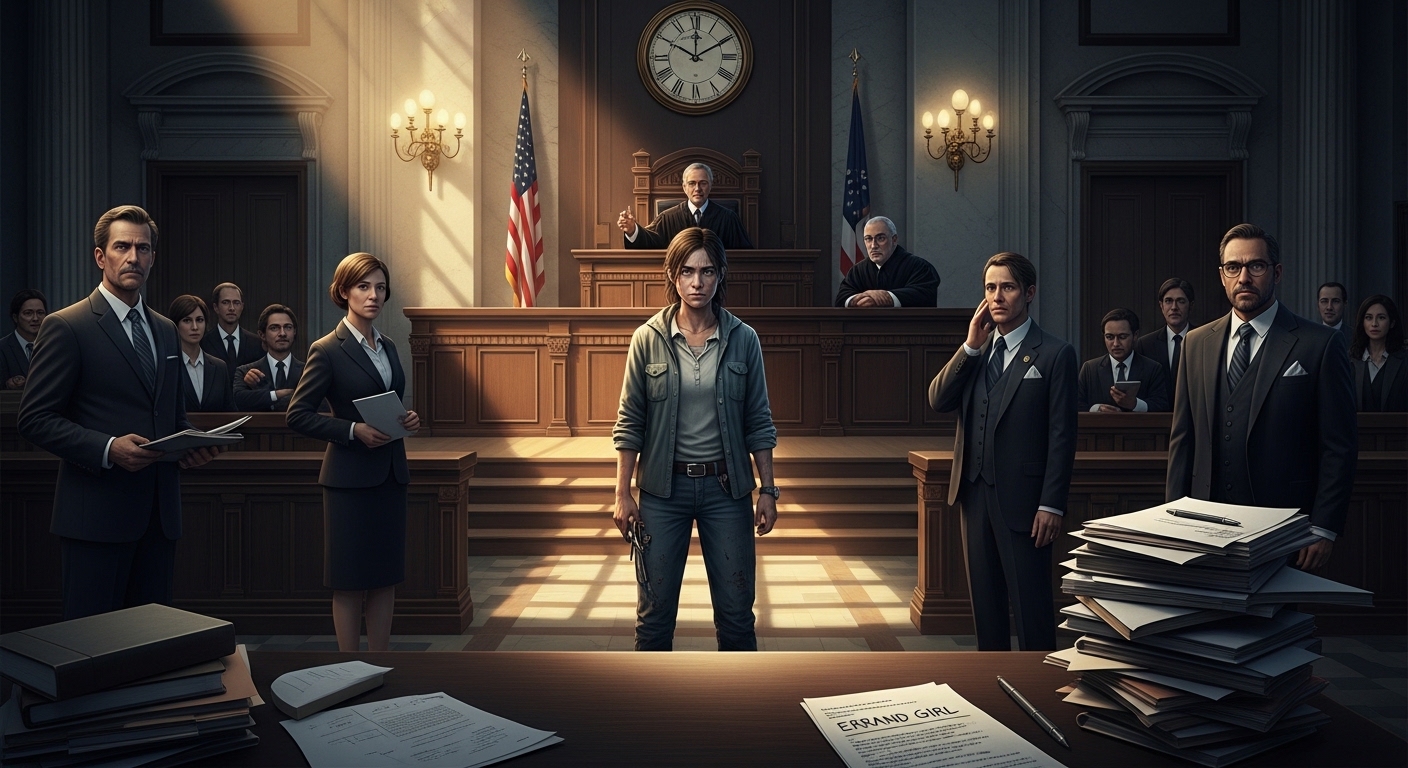
I was the girl who brought the coffee. The one who folded the grease-stained fatigues while the “real men” sat around a topographical map, barking about honor, blood, and the tactical superiority of the American soldier. To the men of the 75th, I was Elena—the quiet, mousy clerk with the oversized BDU jacket and eyes that stayed glued to the floor.
They thought I was a decoration. A convenience. A ghost in the machinery of war.
They didn’t know that ghosts see everything. And they certainly didn’t know that by the time this week was over, I wouldn’t just be folding their laundry. I’d be folding their pride into a tiny, unrecognizable square and handing it back to them in front of the entire brass.
This is the story of how the “errand girl” became the only person in the room who knew how to survive.
CHAPTER 1: THE WEIGHT OF SILENCE
The humidity in North Carolina doesn’t just sit on you; it possesses you. It’s a thick, wet blanket that smells of pine needles, diesel exhaust, and the sour sweat of five hundred men pushing their bodies to the breaking point. At Fort Bragg, the air always feels like it’s waiting for something to explode.
I stood by the industrial percolator in the corner of the briefing room, the steam from the cheap coffee hitting my face. My hands, which Sergeant Miller joked were “too soft for anything but typing and tea,” were steady. That was the first thing they missed. My hands never shook.
“Hey, El! You growing that bean or brewing it?”
The voice belonged to Staff Sergeant Miller. If arrogance had a physical form, it would look like Miller. He was six-foot-two of pure, corn-fed American muscle, with a jawline that looked like it had been chiseled out of granite and a temperament that made a rattlesnake look cuddly. He was the leader of the “God Squad”—a group of elite Rangers who had more combat jumps than I supposedly had brain cells.
“Almost ready, Sergeant,” I said, my voice pitched low, intentionally timid. It was a mask I had spent three years perfecting.
“Move it. We’ve got the Colonel coming in ten, and if his cup isn’t hot, I’m making you do burpees until you puke,” he barked, turning back to his men.
The God Squad laughed. It was a guttural, masculine sound—the sound of men who believed the world was built for them. There was Jax, a demolitions expert with a scar running through his eyebrow; Henderson, the sniper who could hit a moving target from a mile away but couldn’t seem to find the trash can for his tobacco spit; and Miller, the golden boy.
I brought the tray over. My boots—standard issue, polished to a mirror shine despite my “clerk” status—made no sound on the linoleum. I placed the mugs down with surgical precision. One cream, no sugar for Miller. Black for the rest.
“Thanks, sweetheart,” Henderson said, not looking at me, his eyes fixed on the satellite imagery on the table. He reached out and patted my hand—a gesture that was meant to be condescendingly kind, like one would treat a golden retriever.
I didn’t flinch. I just moved back to my corner, a clipboard in my hand, and began “logging” the inventory.
In reality, I was logging them.
Miller: Pulse visible in the neck. High blood pressure. He’d stayed up late drinking—the slight tremor in his left index finger gave him away. Henderson: Dehydrated. The way he kept licking his lips meant his focus was down by at least fifteen percent. Jax: Overconfident. He wasn’t even looking at the secondary extraction point on the map.
They were elite. They were the best the Army had to offer. And they were getting sloppy because they believed there was no one left to challenge them. Especially not a woman whose primary job description involved ordering more printer toner.
“Alright, listen up,” Miller growled, leaning over the map. “The Wargames start at 0400. This isn’t just a drill. The General is looking for the lead element for the Fall deployment. If we lose to the 82nd, I will personally ensure none of you see a weekend pass until 2028. We move fast, we hit hard, and we don’t leave a trail.”
“What about the ‘Infiltrator’?” Jax asked, his voice dropping an octave.
The room went momentarily quiet. The “Infiltrator” was a rumor—a phantom participant added to the wargames by the Pentagon to test the internal security of elite units. No one knew who it was. It could be a Navy SEAL, a Delta operator, or some high-tech sensor drone. The goal of the Infiltrator was to “assassinate” the squad leaders and steal the mission data before the objective was reached.
Miller scoffed, a jagged, ugly sound. “The Infiltrator is a fairy tale told to keep us from getting bored. And even if some Delta hotshot shows up, he’s coming into our house. We know these woods. We know the terrain. No one gets past me.”
I scribbled a note on my clipboard: Arrogance confirmed. Subject Miller believes himself untouchable. Exploitable.
Just then, the heavy double doors swung open, and Marcus Thorne walked in. Marcus was the camp’s head of logistics—a man who looked like he’d been built out of old tires and iron filings. He was a veteran of three wars, with a prosthetic leg that creaked when the weather changed and a heart that he kept hidden under a layer of permanent grumpiness.
“Elena,” he grunted, nodding to me.
“Morning, Marcus,” I replied.
Marcus was the only one who ever really looked at me. Not at me, but into me. He walked over to the coffee pot, poured a cup of the sludge I’d brewed, and leaned against the counter.
“You got the supply manifests for the God Squad’s field kit?” he asked.
“Right here,” I said, handing him a folder.
He flipped through it, his eyes narrowing. He saw the requisitions I’d made—extra thermal dampeners, specialized encryption keys, and high-tensile wire. Things a clerk shouldn’t even know exist, let alone how to order.
He looked at me, then at the God Squad, who were currently mocking Henderson for forgetting his lucky charm. Marcus leaned in close, his voice a whisper that smelled of peppermint and tobacco.
“You’re going to break them, aren’t you?”
I didn’t smile. I didn’t even look up from my clipboard. “I don’t know what you mean, Marcus. I’m just making sure they have enough batteries for their radios.”
Marcus let out a low, dry chuckle. “Careful, kid. Those boys have big egos. When they fall, they make a lot of noise. Make sure you’re not standing under them when it happens.”
“I’m a ghost, Marcus,” I said, finally meeting his eyes. For a split second, the “mousy clerk” vanished, and something cold and sharpened like a razor took its place. “You can’t crush a ghost.”
He nodded, a silent understanding passing between us. Marcus knew. He had been the one to see my real file—the one buried under three layers of “Top Secret” clearance that listed my time in clandestine intelligence and a specialized tactical unit that officially didn’t exist. The Army had “retired” me into this clerk position after a mission in the Balkans went sideways, thinking I needed a “break.”
They thought they were protecting me. They didn’t realize they were just putting a wolf in a sheepfold and forgetting to lock the gate.
The briefing ended with Miller slamming his fist on the table. “Dismissed! El, clean this mess up. And get my rucksack to the transport by 2200. If there’s a single wrinkle in my spare fatigues, you’re dead.”
“Yes, Sergeant,” I said, my voice trembling just enough to satisfy his ego.
I watched them file out, their heavy boots thudding against the floor like the heartbeat of a giant. They were so loud. So heavy. So convinced of their own gravity.
I began clearing the mugs. I picked up Miller’s cup. He’d left a smudge of grease on the rim. I wiped it clean with a white cloth, then looked at my reflection in the window.
The Wargames weren’t just a test for them. They were my escape. I was tired of being the girl who brought the coffee. I was tired of the “sweethearts” and the “honey” and the way they looked through me like I was made of glass.
Tonight, the Infiltrator would begin her work.
And Sergeant Miller was about to find out that the most dangerous person in the room isn’t the one holding the gun. It’s the one holding the keys, the coffee, and every single one of your secrets.
As I walked out of the briefing room, carrying the tray of empty mugs, I passed Sarah Jenkins, a young private who worked in the motor pool. She was crying, her face smudged with oil.
“What’s wrong, Sarah?” I asked, stopping.
“It’s Jax,” she sobbed, looking around to make sure no one was watching. “He… he told the Lieutenant I was the one who messed up the humvee’s transmission. It wasn’t me, Elena. He was the one driving it like a maniac during the night exercises. But the Lieutenant believes him. He said I’m just a ‘clumsy girl’ who shouldn’t be touching engines.”
I felt a cold flicker of rage in my chest. This was the culture they built. A culture where their mistakes were blamed on those they deemed “lesser.”
I reached into my pocket and handed her a clean tissue. “Don’t cry, Sarah. Not for them.”
“They’re the God Squad,” she whispered. “They can do whatever they want.”
“No,” I said, my voice as hard as a diamond. “They can do whatever we let them do. Go home, Sarah. Get some sleep. Tomorrow is going to be a very bad day for Sergeant Jax.”
“Why?” she asked, wiping her eyes.
I smiled, and for the first time in three years, it was a real smile. “Because the God Squad is about to find out that when you spit on the floor, you eventually have to slip on it.”
I left her there, stunned, and walked toward the supply depot.
The sun was setting over Fort Bragg, casting long, bloody shadows across the parade ground. The lights in the barracks were flickering on, one by one. Somewhere in the distance, a bugle was playing Taps, the mournful notes hanging in the humid air.
I reached my small, cramped office at the back of the depot. I locked the door. I reached under the floorboards and pulled out a matte-black Pelican case. Inside wasn’t a typewriter or a stack of forms.
Inside was a suppressed subcompact, a suite of signal-jamming equipment, and a thermal-cloaking suit that cost more than Miller’s house.
I checked the time. 2100 hours.
In one hour, I would deliver Miller’s rucksack. And inside that rucksack, hidden in the lining of his “perfectly folded” fatigues, would be a small, GPS-linked transmitter that would allow me to track his every breath.
The “errand girl” was clocked out.
The Infiltrator was on the clock.
And honor? Honor was about to become a very expensive commodity.
CHAPTER 2: THE ART OF THE GHOST
The North Carolina woods at night are a symphony of deceptive sounds. There is the rhythmic clicking of cicadas, the sudden, sharp snap of a dry branch, and the low, mournful hoot of an owl that sounds almost human if you listen long enough. To an untrained ear, it’s just nature. To a Ranger, it’s a tactical map.
But to me, it was a playground.
I moved through the underbrush like a liquid shadow. I wasn’t wearing the heavy, clunky boots the God Squad wore—boots that announced your presence to the earth with every thud. I wore specialized, thin-soled tactical footwear that allowed me to feel the vibration of the ground, to know exactly where a twig lay before I stepped on it.
I was no longer Elena the clerk. I was the Infiltrator, a ghost born from a thousand hours of silent training and a decade of being ignored.
The wargames had officially begun four hours ago. The God Squad had deployed from the transport at 0300, disappearing into the dense treeline of the “Box”—the restricted training area designed to mimic the rugged terrain of the Hindu Kush. They thought they were being tracked by a drone or perhaps a highly trained OPFOR (Opposing Force) unit. They were looking for a squad of men.
They weren’t looking for the girl who knew exactly how much sugar they liked in their coffee.
I adjusted my headset. A low, static-filled voice crackled in my ear.
“Infiltrator, this is Control. Do you have eyes on the target?”
The voice belonged to Major Evelyn Reed. She was a woman who had fought her way up through the male-dominated ranks of Military Intelligence with a serrated edge and a poker face that could freeze fire. She was one of the few people who knew my real name, and she was the one who had pulled the strings to get me into this exercise.
“Eyes on,” I whispered. My voice was barely a breath. “The God Squad is currently holding at Waypoint Bravo. They’re over-extended. Miller is pushing them too hard to make time.”
“Understood,” Reed replied. “The General is watching the live feed from the thermal satellite. He’s skeptical, Elena. He thinks Miller’s boys are untouchable. He called you a ‘diversity hire’ five minutes ago.”
I felt a cold, familiar spark of anger, but I dampened it immediately. Anger was noise. I needed silence. “Let him think that, Major. It’ll make the reveal more expensive for him.”
“Copy that. Proceed with Phase One. Just… try not to break them too badly. We still need them for the Fall deployment.”
“No promises,” I said, and cut the comms.
I crept closer to their perimeter. Miller had set up a classic diamond formation. Henderson was on the high ground to the north, his long-range rifle scanning the clearing. Jax was to the south, likely setting up tripwires. Miller and the rest were in the center, huddled over a digital tablet.
They were doing everything by the book. That was their first mistake. The book was written by people like them, for people like them. It didn’t account for someone who didn’t play by the rules of ego.
I reached into my webbing and pulled out a small, palm-sized device—a signal burst transmitter. I had spent the last three months “servicing” the God Squad’s communication gear. Every time I “fixed” a radio or updated a firmware, I was actually installing a backdoor.
I pressed a button.
A mile away, a pre-set sonic decoy triggered. It emitted the distinct, low-frequency hum of a low-flying surveillance drone.
Instantly, the God Squad reacted. I watched through my thermal goggles as Miller’s heat signature jerked upward.
“Contact! North-Northwest!” Miller’s voice crackled over the encrypted channel—a channel I was currently monitoring. “Henderson, you see that?”
“Nothing on thermal, Boss,” Henderson’s voice came back, sounding strained. “Wait… I’ve got a ghost signal. It’s moving fast. Too fast for a drone.”
“It’s the Infiltrator,” Jax growled. “He’s trying to flush us out. Hold your positions. Don’t give him the satisfaction.”
They stayed still for ten minutes. The tension in the air was palpable, even from fifty yards away. They were elite, yes, but they were also human. And humans, when faced with an invisible enemy, start to imagine monsters in the shadows.
I moved to the east, circling behind Henderson’s position. Henderson was the best marksman in the unit, but he had a weakness I’d discovered months ago: he was a creature of habit. Every twenty minutes, he’d shift his weight to his left hip because of an old high school football injury he refused to report to the Medics.
I waited. Nineteen minutes. Twenty.
Right on cue, Henderson shifted. He took his eye off the scope for exactly three seconds to rub his lower back.
In those three seconds, I was behind him.
I didn’t use a weapon. I didn’t need to. I reached out and tapped him on the shoulder.
He spun around, his hand flying to the combat knife at his belt, but I was already gone. I had slipped back into the darkness of a thicket of mountain laurel.
But I’d left a calling card.
Henderson froze. On his shoulder, stuck to his multicam jacket, was a small, bright pink Post-it note.
On it, in my neat, clerk’s handwriting, were the words: You’re dead, Henderson. Should’ve seen the physical therapist.
I heard his breath hitch. A ragged, terrified sound.
“Miller!” Henderson hissed into his radio, his voice trembling. “He was here. He was right behind me.”
“Report! What are you talking about?” Miller’s voice was sharp with irritation.
“The Infiltrator. He… he touched me, Miller. He left a note. I’m dead. By the rules of the game, I’m out.”
“Bullshit!” Miller roared. “There’s no one out there! It’s a psych-op. Ignore it. Get back on the glass.”
“I can’t ignore it, Miller,” Henderson whispered, looking around wildly. “If this was real… I’d have a throat full of steel right now. He’s out there. And he’s mocking us.”
I was already moving toward Jax.
Jax was the muscle. The bully. The one who had humiliated Sarah Jenkins. He was currently crouched near a fallen log, his eyes darting back and forth. He was the kind of man who dealt with problems by hitting them. But you can’t hit a shadow.
I pulled out a small spray canister. It contained a highly concentrated, synthetic pheromone—something I’d requisitioned from the experimental labs under the guise of “cleaning supplies.” To a human, it was odorless. To the local black bears, it was the smell of a rival encroaching on their territory.
I sprayed a light mist on the back of Jax’s rucksack as I ghosted past him. He didn’t even feel the air move.
Then, I retreated to a safe distance and waited.
Five minutes later, the woods erupted. Not with gunfire, but with the terrifying, guttural roar of a four-hundred-pound black bear.
Jax screamed. It wasn’t a “Ranger” scream. It was the high-pitched, primal shriek of a man who realized he was no longer the apex predator.
“Bear! Bear!” Jax yelled, scrambling backward, tripping over his own tripwire.
A flashbang went off—his own trap—blinding him and further enraging the bear. The God Squad’s formation broke. Miller was shouting orders that no one was following. Henderson was sitting on the ground, staring at his pink Post-it note like it was a death warrant.
I sat on a mossy outcrop, watching the chaos through my goggles. I felt a cold sense of satisfaction. These were the men who called me “sweetheart.” These were the men who thought that because I didn’t carry a rifle in the light of day, I was beneath them.
But the night doesn’t care about rank. The night only cares about who belongs in it.
“Phase One complete,” I whispered into my comms.
“Elena,” Major Reed’s voice came through, and I could hear the smirk in her tone. “The General just spilled his coffee. He wants to know how a single operative just dismantled his ‘Gold Standard’ squad in under an hour without firing a single shot.”
“Tell him the ‘errand girl’ is just getting started,” I said.
I stood up, the shadows wrapping around me like a tailored suit.
“Now, let’s talk about Sergeant Miller.”
If the God Squad was a body, Miller was the brain. And to truly destroy a body, you have to make the brain stop trusting the limbs.
By 0500, the God Squad was a mess. They had retreated to a “secure” fallback point—a small concrete bunker left over from the Cold War, buried in the side of a hill. They were tired, jumpy, and, most importantly, they were starting to turn on each other.
I crept up to the ventilation shaft of the bunker. I could hear them through the heavy metal grating.
“He’s not even human,” Henderson was muttering. He was still holding the pink note. It had become a talisman of his failure. “He moved through my perimeter like he was made of smoke. No thermal signature, no sound. Nothing.”
“Shut up, Henderson,” Miller snapped. He was pacing the small room, his boots clicking rhythmically—click, click, click. He was agitated. The tremor I’d noticed in the briefing room was back, worse now. “It’s a trick. Some new tech from DARPA. They’re using us as guinea pigs.”
“And the bear?” Jax asked. He was covered in mud and soot from the flashbang. His bravado was gone, replaced by a twitchy, nervous energy. “Was the bear DARPA tech too? It went straight for me, Miller. It ignored everything else and came for me.”
“Bad luck,” Miller growled. “We regroup at dawn. We have the mission data. As long as we get that to the extraction point, we win. Everything else is just noise.”
“Is it?”
The voice came from the corner of the room. It was Private First Class “Dizzy” Diaz, the young radio tech. He was a skinny kid from San Diego, with a shock of black hair and a brain that worked faster than his mouth. The God Squad usually used him as a footstool, but right now, he was looking at his laptop with a look of pure horror.
“What is it, Diaz?” Miller barked.
“The files,” Diaz whispered, his fingers flying over the keys. “The mission data… the encrypted coordinates for the Fall deployment…”
“What about them?”
“They’re gone, Sergeant. Replaced.”
Miller lunged forward, grabbing Diaz by the collar and pulling him toward the screen. “What do you mean, replaced?”
“Look,” Diaz said, pointing to the screen.
Instead of the highly classified tactical maps and troop movements, the screen was filled with a single, scrolling document.
It was a spreadsheet.
A very familiar spreadsheet.
It was the Fort Bragg Logistics and Supply Manifest for the month of October.
Miller stared at it, his face turning a deep, bruised purple. “This is… this is Elena’s office work. This is the coffee budget. The laundry requisitions. The toner orders.”
“There’s a note at the bottom,” Diaz said, his voice trembling.
Miller leaned in. The text was highlighted in bright, mocking red:
Sergeant Miller,
You were so worried about the ‘real’ war that you forgot who runs the one you’re actually in. You can’t fight if you don’t have boots. You can’t shoot if you don’t have bullets. And you can’t lead if you don’t have a clue.
By the way, you’re out of cream. I’ll make sure to order more for your retirement party.
– The Errand Girl.
The silence in the bunker was deafening. It was the sound of a legacy shattering.
Miller let out a roar of pure, unadulterated rage. He slammed his fist into the laptop screen, shattering the glass.
“ELENA!” he screamed, his voice echoing up the ventilation shaft and into the cold morning air. “I’LL KILL YOU! I’LL FUCKING KILL YOU!”
I stood atop the hill, looking down at the bunker. The sun was just beginning to peek over the horizon, casting a pale, golden light over the forest.
I reached up and clicked my radio.
“Major Reed?”
“Go ahead, Elena.”
“Target is neutralized. The God Squad has suffered a total psychological and tactical collapse. I’m heading to the extraction point now.”
“Copy that. The General is… well, let’s just say he’s currently rethinking his stance on office personnel. See you at the finish line, Infiltrator.”
I turned away from the bunker and began to run. Not the heavy, pounding run of a soldier, but the effortless, rhythmic glide of a hunter.
I had three miles to go. Three miles until I stepped out of the woods and back into the world of “Yes, Sergeant” and “No, Sergeant.”
But the world wouldn’t be the same.
Because today, everyone at Fort Bragg was going to learn a very important lesson:
The most dangerous weapon in the United States Army isn’t a missile, a tank, or a Ranger.
It’s the person you think isn’t worth noticing.
As I reached the edge of the training area, I saw a familiar figure waiting by a black SUV. It was Marcus Thorne. He was leaning against the hood, a thermos in his hand, looking like he’d been there all night.
I slowed to a walk, my breath steady, my heart rate already returning to its resting state. I stripped off my thermal suit, revealing the standard-issue BDUs I wore underneath. I tousled my hair, slumped my shoulders, and put on my glasses.
The Ghost vanished. The clerk returned.
Marcus watched me approach. He didn’t say anything at first. He just poured a cup of coffee and handed it to me.
“Black?” he asked.
“Two sugars,” I said, taking a sip. It was perfect.
Marcus looked out at the woods, where the distant sound of Miller’s screaming could still be heard.
“You did it,” he said softly. “You actually did it.”
“I don’t know what you’re talking about, Marcus,” I said, a small, tired smile playing on my lips. “I just got lost on my way to the supply depot. It’s a big forest.”
Marcus grunted, a sound that was half-laugh, half-respect. “The brass is in an uproar. Miller’s career is over. He’ll be lucky if they let him command a mop closet in Alaska after this. And the Infiltrator? The General is calling it the most successful exercise in the history of the 75th.”
“Good,” I said. “Maybe now they’ll start paying attention to the details.”
“Maybe,” Marcus said. He looked at me, his eyes full of a strange, paternal pride. “But you know what the best part is?”
“What?”
“Miller still thinks it was a man. He’s telling everyone it was some six-foot-five Delta operator with experimental cloaking tech. He can’t even conceive that it was you.”
I looked down at my hands—the “soft” hands that had just dismantled the Army’s finest.
“Let him keep his delusions, Marcus,” I said. “It’s the only thing he has left.”
I climbed into the SUV. As we drove away, I looked back at the woods.
The sun was fully up now, burning away the mist and the shadows. The “Ghost of Fort Bragg” was gone, back into the filing cabinets and the coffee runs.
But as we passed the motor pool, I saw Sarah Jenkins. She was standing by a humvee, her chin held high, a wrench in her hand. She saw me and gave a tiny, almost imperceptible nod.
She knew.
And that was enough.
CHAPTER 3: THE WEIGHT OF THE CROWN
There is a specific kind of silence that follows a disaster in the military. It’s not the peaceful silence of a job well done; it’s the heavy, suffocating silence of a courtroom right before the judge reads a life sentence.
Back at the main garrison of Fort Bragg, the air was thick with it.
I was back in my office by 0800, my hair damp from the morning mist, my uniform crisp and smelling of industrial laundry detergent. I had three stacks of requisitions to process and a broken printer that needed a new fuser unit. To any passerby, I was the picture of administrative efficiency—the invisible heart of the logistics department.
But under my desk, my shins were bruised from climbing over limestone outcrops, and my heart was still beating with the jagged, electric rhythm of the hunt.
The base was buzzing. Usually, the post-wargame chatter is about who ran the fastest or who had the best “kill” count. Not today. Today, the only name on anyone’s lips was The Infiltrator.
“I heard it was a Navy SEAL from Team Six,” Private Simmons whispered to Sarah Jenkins near the water cooler. “My cousin is in the 82nd, and he said they saw a guy in a full-body camo suit that literally made him invisible. Like Predator.”
Sarah glanced toward my office door. She didn’t say anything, but I saw the way her hand tightened around her paper cup. She was the only one who had seen the “clerk” look her in the eye and promise a reckoning.
“It wasn’t a SEAL,” another voice chimed in. It was Henderson.
He looked like he hadn’t slept in a decade. His eyes were bloodshot, and his hands were tucked deep into his pockets, but I could still see the slight tremor in his shoulders. He looked like a man who had seen a ghost and was waiting for it to come back for the rest of him.
“How do you know, Henderson?” Simmons asked.
Henderson didn’t answer. He just walked away, his head down. He was no longer the arrogant sniper who had patted my hand like a dog. He was a broken instrument.
I turned back to my computer. I had a job to do.
Around noon, the summons came.
“Elena, the General wants coffee in the tactical suite. Now,” Major Reed’s voice came over the intercom. She sounded professional, but there was a sharp, warning edge to her tone.
I filled the large silver urn, gathered the cream and sugar, and made my way to the inner sanctum of the command building. This was where the “Big Brass” lived—the men with stars on their shoulders and the power to move armies with a stroke of a pen.
When I entered the tactical suite, the atmosphere was radioactive.
General Vance—a man who looked like he’d been carved out of a very old, very angry oak tree—was sitting at the head of the conference table. Beside him were several colonels I didn’t recognize, and at the far end, looking like a caged animal, was Staff Sergeant Miller.
Miller was a mess. His uniform was stained with mud he hadn’t bothered to wash off, and his jaw was set so tight I thought his teeth might shatter.
“And you’re telling me, Sergeant,” General Vance said, his voice a low, terrifying rumble, “that a single operative—one person—neutralized your entire squad, sabotaged your communications, and replaced your mission data with… what was it again?”
“A coffee budget, sir,” one of the colonels whispered, looking at a printout.
Vance slammed his hand on the table. The coffee cups I was currently setting down rattled. I didn’t flinch. I just moved to the next setting, pouring cream into a cup with a steady hand.
“A coffee budget,” Vance repeated, his eyes boring into Miller. “You are the leader of the God Squad. You are the elite. And you let a ghost turn your mission into a grocery run.”
“Sir, it was technical failure,” Miller barked, his voice cracking. “The sensors were jammed by high-frequency interference. We were lured into a bear’s den by synthetic pheromones. This wasn’t a soldier; it was a lab-engineered experiment. We were set up to fail.”
I reached Miller’s side. I poured his coffee. Black. No sugar.
“Your coffee, Sergeant,” I said softly.
Miller didn’t even look at me. He swiped at the cup, nearly knocking it over. “Get out of here, Elena! Can’t you see we’re in the middle of a debrief?”
“I apologize, Sergeant,” I said, my voice shrinking. I looked at the General with a wide-eyed, “frightened” expression.
General Vance looked at me, then at Miller. For a second, I saw a flash of disgust in the General’s eyes. Not at me, but at the way Miller treated the help.
“Sit down, Sergeant,” Vance commanded. “And leave the clerk alone. She’s the only one in this room who seems to be doing her job properly today.”
I retreated to the corner, standing by the sideboards as if waiting for further instructions. In reality, I was the most dangerous person in the room, and no one knew it.
“We have the telemetry from the Infiltrator’s suit,” Major Reed said, stepping forward. She opened a folder on the digital display. “The operative moved with a level of stealth we haven’t seen in twenty years. They didn’t use a single piece of standard-issue weaponry. Everything was psychological. Everything was based on exploiting the specific weaknesses of your men, Miller.”
“Weaknesses?” Miller spat. “We don’t have weaknesses.”
“Henderson has a hip injury he hid,” Reed said, checking her notes. “The Infiltrator used that to time a physical approach. Jax is notoriously hot-headed and prone to panic in unpredictable environments. The Infiltrator used a black bear to trigger a flight response. And you, Miller…”
She paused, looking at the Sergeant.
“You are arrogant. You assumed the threat would come from the outside. You never checked your own rucksack. You never checked your own secure server.”
Miller looked like he was about to explode. “Who was it? I want a name. I want to know who the hell thinks they can humiliate me like this.”
The General stood up. He walked over to the window, looking out at the parade ground.
“The Infiltrator’s identity is classified at a level you don’t have access to, Miller,” Vance said. “But I will tell you this: they aren’t some ‘lab-engineered experiment.’ They are a member of this command. Someone you likely pass every single day. Someone who has been watching you, learning you, and waiting for the moment you grew too big for your boots.”
I felt a thrill of cold electricity run down my spine. The General was closer to the truth than he realized.
“As of this moment,” Vance continued, “The God Squad is disbanded. You are all reassigned to the 2nd Infantry Division for ‘re-training.’ Your recommendation for the Fall deployment is revoked.”
Miller went pale. This was a death sentence for his career. Re-training? That was for recruits. For failures.
“Sir, please—”
“Dismissed, Sergeant,” Vance said, not even turning around.
Miller stood up, his chair screeching against the floor. He marched toward the door, but as he passed me, he stopped. He leaned in, his breath smelling of stale cigarettes and rage.
“You’re enjoying this, aren’t you?” he hissed, low enough that only I could hear.
I looked up at him, my eyes wide and innocent. “I’m just here for the coffee, Sergeant.”
He stared at me for a long second. For the first time, a flicker of suspicion crossed his face. He looked at my hands. He looked at my boots. He looked for the girl he’d ignored for three years, and for a split second, he saw the predator.
I didn’t blink. I didn’t move. I just held the empty tray against my chest.
“Move it, Miller!” Vance roared from the window.
Miller tore his eyes away and stormed out of the room.
The aftermath was swifter than I expected. By the next morning, Jax and Henderson had been packed onto a transport truck. I saw them leaving through the window of the depot.
Henderson looked relieved, in a strange way. He was a man who had been living a lie, pretending to be a “god” when he was just a human with a bad hip. Being exposed had been a trauma, but it was also a release.
Jax was different. He was screaming at the driver, kicking the side of the truck. He was a bully who had lost his playground.
But Miller… Miller didn’t leave. He had “accrued leave” he was forced to take before his reassignment. And he spent that leave stalking the base like a wounded predator.
I was leaving the office late on Thursday night. The rain was coming down in sheets, turning the red clay of North Carolina into a slick, treacherous mess. I was walking toward my old sedan when a shadow detached itself from the side of the building.
“Going somewhere, El?”
It was Miller. He was wearing a civilian raincoat, his hood pulled low, but I could see the glint of his eyes. He was holding a bottle of bourbon in one hand.
“It’s late, Sergeant,” I said, my hand instinctively reaching for the small of my back, where I usually kept a blade. I wasn’t carrying tonight. I was “Elena” tonight. I had to be careful.
“You know,” Miller said, taking a slow, swaying step toward me. “I spent all day in the motor pool. Talking to the mechanics. Talking to Sarah Jenkins.”
My heart skipped a beat, but I kept my face neutral.
“Sarah’s a good kid,” I said.
“She’s a rat,” Miller spat. “But she’s a scared rat. I asked her about the night the humvee transmission blew. The night I supposedly ‘lied’ about who was driving.”
I stayed silent.
“She told me you were the one who told her to stand up to me,” Miller continued, his voice dropping to a dangerous whisper. “She told me you were the one who ‘knew’ I was lying. How did you know, Elena? You weren’t even on the range that night. You were supposed to be in the depot, filing papers.”
“People talk, Sergeant. I just listen.”
“No,” Miller said, dropping the bottle. It shattered on the pavement, the smell of cheap booze filling the air. “You don’t just listen. You’re the ghost, aren’t you? You’re the one who touched Henderson. You’re the one who put the bear on Jax.”
He laughed, a jagged, manic sound.
“The errand girl. The clerk. My god, it’s hilarious. The Army’s greatest secret is a woman who spends her day ordering paperclips.”
He lunged for me.
In a normal world, a six-foot-two Ranger would have crushed me. But this wasn’t a normal world.
I didn’t run. I didn’t scream.
As he reached for my throat, I stepped inside his guard. It was a move from Krav Maga—fast, brutal, and efficient. I grabbed his wrist, used his own momentum against him, and drove my palm into the base of his chin.
His head snapped back. I followed up with a sweep of his lead leg.
Miller hit the wet pavement with a sickening thud. The air left his lungs in a ragged whoosh.
I didn’t stop. I knelt over him, my knee pressed firmly into his carotid artery—not enough to kill him, but enough to let him know how easy it would be.
The rain lashed at us. My glasses had fallen off, and for the first time, Miller saw the real me. The one from the Balkans. The one who had survived things he couldn’t even imagine in his worst nightmares.
“Listen to me, Miller,” I whispered, my voice cutting through the sound of the storm like a knife. “You are going to take your reassignment. You are going to go to the 2nd Infantry. You are going to keep your mouth shut about me, and you are going to spend the rest of your miserable career being the best, most humble soldier you can be.”
“Or… or what?” he wheezed, his eyes bulging.
“Or I’ll stop being a ghost,” I said, leaning in closer until our noses almost touched. “I have your medical records. I have your bank statements. I know about the ‘kickbacks’ you’ve been taking from the local equipment contractors. I have enough on you to ensure you don’t just lose your rank—you lose your freedom.”
I let go of his neck and stood up. I wiped the rain from my face.
“You think you’re a god, Miller. But gods are just stories we tell to feel safe in the dark. I am the dark.”
I turned and walked to my car. I didn’t look back. I heard him coughing on the pavement, a pathetic, broken sound that was quickly swallowed by the rain.
The next morning, Miller was gone. He’d checked out of the barracks at 0400 and headed for his new post. He didn’t say goodbye to anyone.
I sat at my desk, a fresh cup of coffee in my hand.
Major Reed walked in a few minutes later. She didn’t say anything. She just placed a small, velvet box on my desk.
“What’s this?” I asked.
“The General wanted you to have it,” she said. “It’s not an official medal. You can’t wear it on your uniform. But it’s a token of appreciation from the people who actually know who runs this base.”
I opened the box. Inside was a small, silver pin in the shape of a key.
“A key?”
“To the kingdom,” Reed said with a wink. “And also to a new office. You’re being promoted, Elena. You’re moving out of logistics.”
“To where?”
“To the 13th Tactical Support Group. You’ll be their ‘administrative liaison.’ But your real job? You’re going to be training the next generation of Infiltrators. The General realized we have a massive blind spot. We’re so busy looking for the enemy’s tanks that we forget to look at the people cleaning the floors.”
I looked at the silver key. It felt heavy in my hand.
I thought about Sarah Jenkins, who was finally getting the credit she deserved in the motor pool. I thought about Marcus Thorne, who was probably laughing into his thermos somewhere. And I thought about Miller, who was finally learning what it felt like to be invisible.
“I’m going to need a bigger coffee pot,” I said.
Major Reed laughed. “I’ll put it on the requisition list.”
As she walked out, I looked at my reflection in the window. The “clerk” was still there—the mousy hair, the plain clothes, the quiet eyes. But behind the glass, the ghost was smiling.
The wargames were over. But the real work was just beginning.
Because in a world full of “God Squads,” someone has to be the one to remind them that they’re only human. And I was more than happy to be that someone.
CHAPTER 4: THE ARCHITECT OF SHADOWS
The transition from the logistics depot to the 13th Tactical Support Group wasn’t marked by a parade or a ceremony. There were no brass bands for the girl who had spent three years blending into the beige wallpaper of Fort Bragg. My new office was in a building that didn’t appear on the public base maps—a low-slung, windowless structure of reinforced concrete tucked behind a grove of ancient, weeping oaks.
Inside, the air was climate-controlled and smelled of ozone and expensive hardware. It was a far cry from the scent of diesel and stale coffee I’d grown used to.
I sat at my new desk, looking at the silver key pin. It felt like a heavy weight in my palm. For years, my safety had been my anonymity. I was the ghost, the errand girl, the one who didn’t matter. Now, I was a focal point. I was the person responsible for teaching the Army’s most elite soldiers that they were, in fact, incredibly vulnerable.
Major Reed walked in, carrying two folders. One was thick and red—top secret. The other was a simple manila folder.
“How’s the new view, Elena?” she asked, leaning against the doorframe.
“It’s quiet,” I said, tucking the pin into my desk drawer. “Almost too quiet. I find myself waiting for someone to yell at me for more toner.”
Reed chuckled. “Those days are over. Or rather, they’re just beginning in a different way. You start your first class at 1300. We’ve hand-picked twelve candidates from across the branches. Intelligence, Special Forces, even a few from the Signal Corps.”
“What did you tell them?”
“I told them they were going to meet the person who broke the God Squad. They’re terrified. Half of them think you’re a ghost story, and the other half think you’re a Delta legend coming out of retirement.”
I stood up, smoothing my uniform. “Let’s keep them guessing for a while longer.”
The briefing room was filled with the kind of men and women I used to serve coffee to. They were lean, sharp-eyed, and radiating the restless energy of people who were used to being the smartest and strongest in any room.
As I walked in, the room went silent. Not a respectful silence, but a confused one. They looked at my rank—Specialist—and then at my face. I saw the same flickers of doubt I had seen in Miller’s eyes for years. This? This is the one?
I didn’t go to the podium. I didn’t open a PowerPoint. I just walked to the back of the room and sat in a regular chair, looking at them.
“At 0300 this morning,” I said, my voice quiet but carrying to every corner of the room, “I entered the private quarters of every person in this room.”
A ripple of unease went through the group. A tall, broad-shouldered Captain from the Rangers stood up. “Excuse me, Specialist? That’s impossible. My quarters are inside a secured perimeter with biometric locks.”
I reached into my pocket and pulled out a small, blue plastic toothbrush. “Is this yours, Captain?”
He froze. His hand went instinctively to his face. “Where did you get that?”
I pulled out a pair of silver earrings. A woman from the 82nd gasped, her hand flying to her ears. I pulled out a set of car keys, a lucky coin, and a handwritten letter from someone’s mother.
One by one, I placed the items on the table in front of me.
“You are trained to look for an enemy with a gun,” I said, standing up. “You are trained to look for a thermal signature on a hillside or a suspicious vehicle on a road. You are not trained to look for the person who cleans your hallway. You are not trained to look for the person who delivers your mail. You are not trained to look at the people you think are ‘beneath’ your notice.”
I walked to the front of the room now, my boots making that same silent, predatory rhythm I’d used in the woods.
“The God Squad didn’t lose because they weren’t good soldiers,” I continued. “They lost because they were arrogant. They believed that because they were the ‘best,’ the world would always announce its intentions to them. They forgot that the most dangerous weapon in any arsenal isn’t a bomb. It’s information. And the people with the most information are the ones who are invisible to you.”
The Captain sat down, his face pale. The room was no longer silent with confusion. It was silent with a new, terrifying kind of respect.
“In this course, you aren’t going to learn how to shoot,” I told them. “You already know how to do that. You’re going to learn how to be the person no one remembers. You’re going to learn how to turn your ego into a weapon. And most importantly, you’re going to learn that in the modern world, the ‘errand girl’ is the one who decides whether you live or die.”
The weeks turned into months. My life became a cycle of teaching and training. I watched as these elite soldiers struggled to unlearn their training. I watched them try to “act” invisible, and I had to show them that invisibility isn’t an act—it’s a state of mind. It’s the genuine belief that you are no more important than the dust on the floor.
But while my professional life was flourishing, the echoes of the “old” Elena still lingered.
One afternoon, I was walking through the main PX (Post Exchange) when I saw a familiar face. It was Henderson.
He was wearing civilian clothes—a simple flannel shirt and jeans. He looked different. The hard, jagged edges of his personality had been sanded down. He was holding a small child in his arms, a little girl with blonde curls who was laughing at a stuffed bear.
I hesitated, then decided to keep walking. I didn’t want to bring back the ghost of his failure.
“Elena?”
I stopped. Henderson was looking at me, his eyes wide. He handed the child to a woman beside him—his wife, I assumed—and walked toward me.
“Sergeant Henderson,” I said, nodding.
“Just Brian now,” he said, a sad, small smile on his face. “I took a medical discharge. The hip… well, after the wargames, I couldn’t hide it anymore. The doctors said it was a miracle I was even walking.”
“I’m sorry to hear that,” I said, and for the first time, I meant it.
“Don’t be,” he said. He looked at his wife and daughter, then back at me. “That night in the woods… when you touched my shoulder and left that note. I was angry for a long time. I wanted to find you and… well, it doesn’t matter now.”
He paused, looking down at his boots.
“But then I realized something. You didn’t just ‘kill’ me in a game, Elena. You saved me. If I had gone on that Fall deployment with my hip the way it was, I would have gotten my men killed. I would have been a liability. You showed me the truth before the truth could kill anyone.”
He reached out his hand. Not to pat mine like a dog, but for a real, honest handshake.
“Thank you,” he whispered.
I shook his hand. It was warm, steady, and human. “Good luck, Brian.”
As I watched him walk away, I felt a strange sense of peace. The “destruction” of the God Squad hadn’t just been about revenge. It had been about correction. It had been about taking a system that was broken by ego and forcing it to look at itself in the mirror.
My final test came a year later.
I was summoned to General Vance’s office. This time, I didn’t bring coffee. I brought a laptop and a secure briefing folder.
The General was standing by the window, looking out at a new batch of recruits running drills on the parade ground.
“Sit down, Specialist,” he said, not turning around.
I sat.
“I’ve been reading the reports from your trainees,” Vance said. “The feedback is… unprecedented. We’ve had three successful deep-cover insertions in the last month that were based entirely on the protocols you developed. No one saw them coming. No one even knew they were there until the objectives were met.”
“They’re good students, sir,” I said.
“They are,” he agreed. He finally turned to face me. “But there’s a problem.”
He tossed a folder onto the desk. I opened it. It was a transfer request.
“The Pentagon wants you, Elena. They want to move you to a multi-agency task force in D.C. They want the ‘Ghost of Fort Bragg’ to start working on a global scale.”
I looked at the request. It was everything I should have wanted. Power, prestige, a higher pay grade, and a direct line to the people who shaped the world.
“What do you think, sir?” I asked.
Vance sighed, looking older than I’d ever seen him. “I think you’d be brilliant. I think you’d change the way we fight wars forever. But I also think that if you go, we lose the heart of what you’ve built here.”
He walked over and sat across from me.
“You taught these boys that the people who matter are the ones they don’t notice. But if you move to D.C., you become one of the people everyone notices. You become a ‘Director,’ an ‘Architect.’ You become a target.”
I looked out the window. I saw Sarah Jenkins—now a Sergeant—overseeing a team of mechanics. I saw the way the younger soldiers looked at her with respect. I saw the way the base moved, a complex, beautiful machine where every gear, no matter how small, was finally being seen.
“I’m staying, sir,” I said.
Vance blinked. “Are you sure? This is a massive opportunity.”
“I spent my whole life being invisible,” I said, a small smile touching my lips. “And I found out that’s where the real power is. If I go to D.C., I lose that. Here… here I can make sure the next Elena doesn’t have to wait three years to be heard. I can make sure the next Miller doesn’t get to build a kingdom out of arrogance.”
Vance nodded slowly. “I’ll tell them you declined.”
As I stood up to leave, Vance called out to me one last time.
“Elena?”
“Yes, sir?”
“How did you get into my house last night?”
I stopped at the door. I didn’t turn around.
“Your wife has a very nice garden, sir. And she really appreciated the tips I gave her on the hydrangeas. She let me right in the front door.”
The General let out a loud, booming laugh that echoed through the hallway. “Get out of here, Specialist. Before I have you arrested for being too damn good at your job.”
I walked out of the command building and into the cool autumn air. The sun was setting, casting long, golden shadows across the brick buildings.
I walked toward the logistics depot. I didn’t have to go there, but I wanted to. I walked past the coffee machines, the filing cabinets, and the stacks of paper.
I saw a young girl, a new clerk, sitting at my old desk. She looked tired, her eyes red from staring at spreadsheets. She was holding a stack of requisitions, looking overwhelmed.
A group of young officers walked past her, laughing, not even glancing her way. One of them accidentally knocked a folder off her desk and didn’t even stop to pick it up.
The girl sighed, her shoulders slumping.
I walked over. I picked up the folder and placed it back on her desk.
She looked up, startled. “Oh, thank you, Sergeant… I mean, Specialist.”
“It’s Elena,” I said softly.
She looked at me, her eyes watery. “They just… they don’t even see me. It’s like I’m not even here.”
I leaned in, the silver key pin on my lapel catching the light.
“That’s your superpower, honey,” I whispered. “They don’t see you. Which means you can see everything. And one day, you’re going to be the only person in the room who knows how the whole world works.”
She stared at me, a tiny spark of hope lighting up in her eyes. “Really?”
“Really,” I said. “Now, why don’t you go get a fresh cup of coffee? I’ll finish this stack for you.”
“I… I can’t ask you to do that.”
“Trust me,” I said, sitting on the edge of the desk. “I’ve had a lot of practice.”
As she walked away, I looked at the spreadsheet. It was a mess of numbers and codes. It was boring, invisible, and completely essential.
I started typing.
The world thinks that history is made by the people on the stages, the ones with the microphones and the medals. But I know better. History is made in the kitchens, the basements, and the supply depots. History is made by the people who remember to buy the lightbulbs and the people who know exactly how much sugar the General takes in his coffee.
We are the ghosts in the machine. And as long as they keep ignoring us, we’ll keep running the world.
ADVICE & PHILOSOPHY
In every organization, in every family, and in every room, there is someone you are overlooking.
We live in a culture that worships the loud, the visible, and the aggressive. We assume that “leadership” is a performance and that “power” is a status symbol. But true power is quiet. True power is the ability to observe without being observed, to understand the architecture of a situation before anyone else even realizes there’s a building.
If you are the person who feels invisible today—the “errand girl,” the clerk, the one who brings the coffee—know this:
Your invisibility is not a weakness; it is your greatest tactical advantage. While the “Gods” are busy preening for the cameras, you are learning their secrets. While they are shouting, you are listening. And while they are assuming they are untouchable, you are holding the keys to their kingdom.
Never mistake silence for absence, and never mistake a desk job for a lack of ambition.
The most dangerous person in the room is never the one making the most noise. It is the one who is quietly making sure the noise has a place to echo.
“The world only belongs to the loud until the quiet ones decide they’ve heard enough.”