

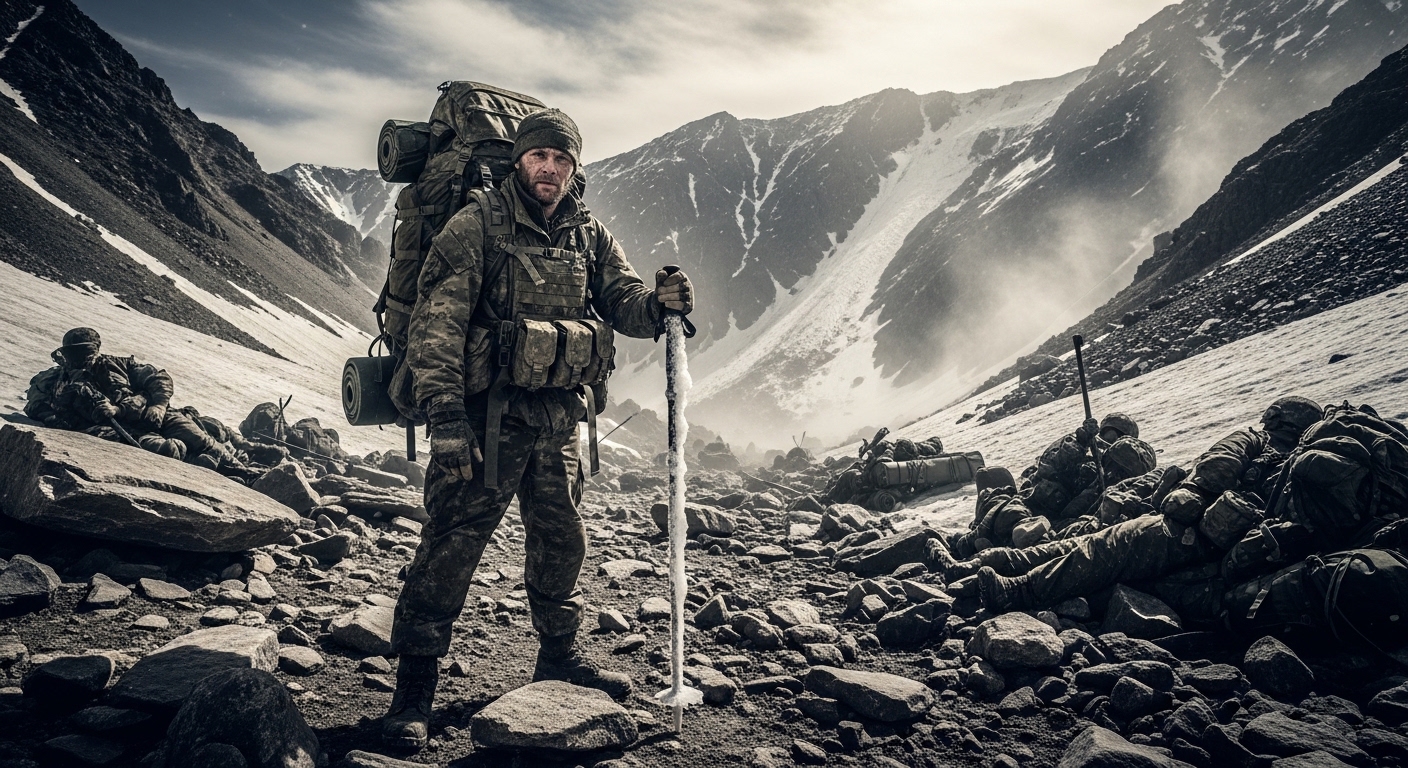
The rain in the Pacific Northwest doesn’t just fall; it colonizes you. It soaks through the “waterproof” Gore-Tex, chills the marrow of your bones, and turns the forest floor into a graveyard of mud and broken spirits.
I stood there, my boots sinking three inches into the muck of Camp Blackwood, while Staff Sergeant Miller threw a forty-pound crate of ammunition at my chest.
“Catch, Vance,” he sneered, his voice like gravel grinding under a tank tread. “Or is that too heavy for your delicate, feminine sensibilities?”
The crate hit me with a dull thud, knocking the wind out of my lungs. I didn’t drop it. I couldn’t. If I dropped it, I’d never hear the end of it. I’d be the “weak link” for the next six months of deployment.
“She’s got it, Sergeant,” Specialist O’Malley—we called him Ox—muttered, though he wouldn’t look me in the eye. Ox was six-foot-four and built like a brick house, but he had the backbone of a chocolate éclair when Miller was around.
“Of course she’s got it,” Miller laughed, turning to the rest of the squad. “Vance is our little pack mule, aren’t you, Lena? Since you can’t seem to hit a target at three hundred yards, you might as well be useful for something. Move those crates to the transport. All of them. Alone.”
The “all of them” consisted of twenty crates. The rest of the squad was heading to the heated mess tent for coffee. I was a 91-Delta—a tactical power generation specialist—but in Miller’s eyes, I was just a girl who had wandered into his man-cave of a platoon.
I didn’t say a word. I just gripped the wet wood of the crate, felt the splinters dig into my palms, and started walking.
I’ve spent my whole life being told I didn’t belong in the rooms I occupied. My father was a mechanic in a town that didn’t believe women should know the difference between a torque wrench and a toaster. I grew up with grease under my fingernails and the sound of men laughing at my “hobby.”
But this was different. This was the U.S. Army, and the mockery here didn’t just hurt my feelings—it was dangerous.
“Hey, Pack Mule!” Private Jenkins yelled from the back of the line, throwing his empty rucksack toward me. “Carry this too? My shoulder’s a bit sore.”
The guys erupted in laughter. I caught the bag. I added it to the pile. I kept moving.
They didn’t know that while they were laughing, I was watching. I was listening. I knew that the fuel lines on the transport trucks were cracked. I knew the radio towers were vibrating at a frequency that suggested a structural failure in the high winds. I knew the mountain we were training on was oversaturated and unstable.
They called me useless. They called me a burden.
But as the clouds turned a bruised purple and the first rumble of a landslide echoed through the valley, I realized that the people who mock you for your “weakness” are usually the first ones to scream when the world starts to fall apart.
And I was the only one who knew how to hold it together.
CHAPTER 1: THE WEIGHT OF SILENCE
The first thing you learn at Camp Blackwood is that silence is a luxury. Between the constant thrum of the generators, the barking orders of NCOs who haven’t slept in forty-eight hours, and the rhythmic thump-thump-thump of Black Hawks overhead, your brain never really gets a moment to breathe.
I’ve always been a creature of the quiet. Back in Oakhaven, Oregon, I’d spend hours in my dad’s garage, just listening to the internal combustion engine. Engines speak to you if you’re patient enough. A skip in the timing, a hiss in the radiator—it’s all a language.
In the Army, no one wants to listen. They just want to shout.
“Vance! Where the hell is my humvee?”
I wiped a streak of blackened oil across my forehead, leaving a smudge that I knew would make me look “unprofessional” in the eyes of the brass. I was hunched over the engine block of an M1151, my fingers numb from the October chill.
“The alternator is shot, Sergeant Miller,” I said, my voice steady despite the fact that I’d been awake since 03:00. “I told you yesterday we needed to pull it from the rotation. The bearings are screaming.”
Miller walked over, his chest puffed out like a rooster in ACUs. He was a man who measured his worth by how much he could make others suffer. He’d been in for twelve years, had two combat tours that he never stopped talking about, and a divorce that clearly ate him alive every night.
“I don’t care about the ‘screaming,’ Vance,” he spat, leaning into my personal space. He smelled like stale coffee and Wintergreen dip. “I care about the mission. We’re moving the platoon to the upper ridge for the live-fire exercise in two hours. That truck moves, or you’re rucking the entire three miles with a base plate on your back. Am I clear?”
“Clear, Sergeant.”
He slapped the hood of the truck, a loud metallic bang that echoed in the garage. “Good. Try not to break a nail, Princess.”
He walked away, joined by Ox and Jenkins. I heard them laughing as they headed toward the latrines.
“You see her face?” Jenkins chuckled. “She looks like she’s about to cry every time Miller breathes on her. Why do they even let ’em in? Seriously. She’s taking up a slot for a real soldier.”
Ox didn’t laugh as loudly, but he didn’t stop them either. Ox was the kind of guy who wanted to be liked so badly he’d let you set his own house on fire if it meant he was part of the “in” crowd. He was a farm boy from Iowa, strong as an ox (hence the name), but he had the internal compass of a broken weather vane.
I looked down at my hands. They were trembling, but not from the cold.
“Don’t let them get to you, Lena,” a soft voice said from the shadows of the next bay.
It was Sarah Jenkins—no relation to the loud-mouthed Private. Sarah was a medic, a small, bird-like woman with eyes that had seen too much during her time at a Level 1 trauma center before she enlisted. She was my only real friend in the unit.
“They’re just assholes who are scared of the storm,” Sarah said, stepping into the light. She was holding two lukewarm cups of coffee.
“What storm?” I asked, taking the cup. My fingers gripped the heat like a lifeline.
“The one the locals are talking about,” she whispered, glancing toward the door to make sure Miller wasn’t lurking. “Record-breaking rainfall. The mountain is already soft. My captain is worried about the roads washing out, but the Colonel wants this exercise finished before the VIPs arrive from D.C.”
I looked out the open garage door. The sky wasn’t just grey; it was heavy. It felt like the clouds were pressing down on the jagged peaks of the Cascades, trying to crush them into the sea.
“The alternator isn’t the only thing that’s going to break, Sarah,” I said.
“What do you mean?”
“The trucks, the generators, the men,” I murmured. “They’re all running at 110% capacity because Miller wants to look like a hero. But you can’t outrun physics. Eventually, things snap.”
The morning progressed with a brutal, grinding efficiency. Because I was “the girl,” I was assigned the tasks that were both physically demanding and socially isolating. While the men worked in teams to load the heavy equipment, I was told to “organize” the overflow shed—which was basically a polite way of saying I had to move hundreds of pounds of rusted gear by myself in the rain while they stayed under the awning.
Every time I passed the squad, there was a comment.
“Hey Vance, you need a man to help you with that? Oh wait, I forgot, you’re ‘strong and independent,’” Jenkins jeered as I lugged a 200-pound portable generator onto a dolly.
“Leave her alone, Jenkins,” Ox said half-heartedly.
“Why? She likes it,” Miller added, leaning against a crate. “Look at her. She’s built for labor. My grandmother used to carry hay just like that in the old country. It’s in her blood.”
I ignored them. I focused on the weight. I focused on the way the dolly’s wheels groaned. I focused on the smell of the coming rain.
I’ve always found that people who talk the most are usually the ones hiding the most weakness. Miller talked about his “war stories,” but I’d seen him flinch when a transformer blew last week. Jenkins talked about his “toughness,” but he was the first to complain if his MRE wasn’t the Chili Mac.
They thought they were the masters of this environment. They thought the Army was a place where “alpha males” ruled and everyone else was just scenery.
By noon, the sky finally opened up. It wasn’t a drizzle. It was a deluge. Within thirty minutes, the gravel paths of Camp Blackwood had turned into rushing streams of brown water.
“Mount up!” Miller yelled, his voice barely audible over the roar of the rain. “We’re heading to Ridge 4. Now!”
I climbed into the driver’s seat of the M1151 I’d been working on. I’d managed to patch the alternator with some luck and a prayer, but the engine didn’t sound right. It had a hollow, rhythmic clicking. A warning.
“Move it, Vance!” Miller hammered on my door. He climbed into the passenger seat, his wet gear soaking the upholstery. Ox and Jenkins piled into the back.
“Sergeant, we shouldn’t be taking the ridge road,” I said, my hand hovering over the gear shift. “The drainage is blocked near the switchback. If the water builds up, that road will turn into a slide.”
Miller looked at me like I’d just suggested we defect to the enemy.
“Are you a geologist now, Vance? Or a meteorologist? No? Then shut up and drive. I’ve got a schedule to keep, and I’m not letting a little rain stop me from getting my Commendation Medal.”
“It’s not just rain, Sergeant—”
“Drive. The. Truck.”
I shifted into drive. The humvee groaned, its tires spinning for a second in the mud before grabbing hold.
As we began the slow, winding ascent up the mountain, the atmosphere inside the truck was suffocating. Miller was on the radio, barking at the other vehicles in the convoy. Ox and Jenkins were in the back, complaining about the leak in the roof.
No one noticed the way the trees were leaning. No one noticed that the birds had gone silent.
“Look at this,” Jenkins laughed, pointing out the window at a small stream that had turned into a raging torrent. “Nature’s a bitch, ain’t she?”
“Just like Vance,” Miller quipped, not even looking at me. “Beautiful to look at, but useless when things get muddy.”
I didn’t respond. I kept my eyes on the road. The switchback was coming up—the sharpest turn on the mountain, with a sheer drop on the right side and a steep, unstable cliff on the left.
The steering wheel felt light in my hands. Too light.
“Sergeant,” I said, my voice low and urgent. “The ground is moving.”
“Shut up, Vance! I’m on the radio!”
“Miller, look!” Ox suddenly shouted from the back.
It didn’t happen like in the movies. There was no giant roar, no cinematic explosion. There was just a sickening slurp—the sound of a billion tons of earth losing its grip on the bedrock.
A wall of mud, rocks, and uprooted pine trees cascaded down the slope directly in front of us.
“Brake! Vance, brake!” Miller screamed.
I didn’t just brake. I knew if I slammed the brakes on this mud, we’d slide sideways off the cliff. I downshifted, feathered the pedal, and steered into the slide, trying to wedge the nose of the humvee against a large, stable-looking boulder.
The impact was violent. The world spun. The windshield shattered into a web of white cracks.
Then, there was the silence.
The truck was tilted at a forty-degree angle. Half of the hood was buried under a pile of shale. Outside, the rain continued to hammer down, but the road ahead was gone. Completely erased. And the road behind us? A second slide had come down, pinning the rest of the convoy back near the base.
We were trapped.
Miller was the first to move. He groaned, clutching his shoulder. “My arm… I think it’s dislocated.”
Jenkins was sobbing in the back. “My leg! I can’t feel my leg!”
Ox was staring out the window, his face white as a sheet. He wasn’t moving at all. He was in total shock.
I was the only one who hadn’t screamed. I checked my vitals—shaken, bruised, but intact. I looked at the dashboard. The radio was dead. The engine was stalled.
“We need to get out,” I said, my voice cutting through the panic.
“We stay here!” Miller hissed, his face contorted in pain. “We wait for Search and Rescue!”
“There is no Search and Rescue, Sergeant,” I said, pointing to the mud still trickling down the cliffside. “That hill is still coming down. If we stay in this truck, we’re going to be buried alive in the next ten minutes.”
I kicked my door open. It wouldn’t budge. The mud had sealed it shut.
I looked at Miller. He was shaking. The “tough guy” was gone. The man who had mocked me for being a “girl” was now looking at me with wide, terrified eyes, waiting for me to tell him what to do.
“Move to the back,” I ordered. Not “suggested.” Ordered.
“But—”
“Move! Now!”
I crawled over the center console, pushing Miller’s sagging body toward the rear. I grabbed a heavy iron pry bar from my toolkit—the one I’d been mocked for carrying everywhere.
With one heave, I smashed the rear window.
“Ox! Help me with Jenkins!”
The giant man blinked, coming back to reality. He saw my face—covered in blood and oil, but calm—and he nodded.
We dragged Jenkins out of the wreckage, his leg twisted at an unnatural angle. We pulled Miller out next. He was whimpering like a child.
We stood on a tiny ledge of stable ground, surrounded by a churning sea of mud and the skeletal remains of the forest. The temperature was dropping. The sun was disappearing. We were three miles from base, with a wounded man, a coward, and a leader who had completely broken down.
I looked at my squad. The men who had called me a pack mule. The men who had told me I was useless.
“Alright,” I said, wiping the rain from my eyes. “If you want to live, you’re going to do exactly what the ‘girl’ says. Ox, grab the emergency kit. Miller, hold this bandage to Jenkins’ leg. I’m going to get us off this mountain.”
Miller looked up at me, his lip trembling. “How? The road is gone.”
I looked at the mountain. I saw the patterns in the rocks, the way the water was flowing. I saw the mechanical logic of the terrain.
“I’m a mechanic, Sergeant,” I said. “I know how to fix things that are broken. And right now? You’re all broken. I’m the only one left who works.”
I turned away and started climbing.
CHAPTER 2: THE ANATOMY OF A BREAKING POINT
The human body is essentially a machine, and like any machine I’ve ever worked on, it has a failure point. For some, it’s a bolt that snaps under too much torque. For others, it’s a fuel line that clogs until the engine starves and dies. Watching Staff Sergeant Miller sit in the mud, cradling his arm and staring blankly at the abyss where the road used to be, I realized his failure point wasn’t physical. He had simply run out of the only fuel that kept him going: his sense of superiority.
Without a rank to hide behind or a subordinate to belittle, Miller was just a middle-aged man in wet clothes, shivering in the dark.
“We’re going to die here,” Jenkins whispered. He was lying on a poncho we’d spread over the relatively flat surface of a rock outcropping. His leg was a mess—a compound fracture of the tibia. The bone hadn’t pierced the skin yet, but the swelling was turning his calf into a purple balloon.
“Shut up, Jenkins,” I said, not out of cruelty, but because panic is more contagious than the flu. “You’re not dying. You’re just going to have a very expensive story to tell at the bar when we get home.”
I turned to Ox. He was standing near the edge of the slide, looking down. In the fading light, the valley below looked like a churning cauldron of gray soup. You couldn’t tell where the trees ended and the mud began.
“Ox! Look at me,” I barked.
He turned slowly. His eyes were wide, the pupils blown out. He was “thousand-yard-staring” me. I walked over and grabbed the front of his tactical vest, yanking him forward until our foreheads almost touched.
“I need you, Specialist. I can’t carry Jenkins alone, and Miller is out of the fight. Do you hear me? I need your strength. Right now.”
Ox blinked, and for a second, I saw the farm boy from Iowa return. The one who spent his summers tossing hay bales and fixing tractors. He nodded once, a sharp, jerky movement. “What do we do, Vance?”
“We can’t stay here,” I said, letting go of his vest. “The drainage is still blocked above us. Look at those trees.” I pointed up the slope. A cluster of ancient Douglas firs was leaning at a thirty-degree angle. “The soil is liquefied. If that patch lets go, this ledge is gone. We have to move laterally, across the slide, to that rocky spine about half a mile east. It’s solid granite. It won’t move.”
“Across the slide?” Miller suddenly spoke up, his voice cracking. “That’s suicide. It’s like walking across a river of wet concrete. We stay here. That’s an order, Vance.”
I looked at him. Really looked at him. The mud on his face was beginning to dry in the wind, making him look like a cracked statue.
“With all due respect, Sergeant,” I said, and for the first time in three years, I didn’t feel a flicker of fear when I spoke to him. “Your orders got us buried. My intuition is going to get us out. You can stay here and wait for the mountain to finish the job, or you can get up and follow the ‘useless’ girl. I’m moving Jenkins in five minutes.”
I walked away from him before he could respond. I didn’t have time for the chain of command. The chain was broken.
I knelt by my rucksack. I always carried an extra fifty feet of 550 cord and a couple of heavy-duty ratcheting tie-downs. Most soldiers carried extra ammo or snacks; I carried hardware. I started searching the debris field near the wrecked humvee. I found two sturdy branches from a downed pine and a piece of the humvee’s torn canvas roof.
“Ox, help me lash these,” I said.
We built a makeshift litter. It wasn’t pretty, but it was functional. As I worked, my mind drifted back to Oakhaven.
I remembered being twelve years old, sitting in the dirt behind my father’s garage. He was trying to hoist a transmission out of an old ’88 Chevy, but the chain hoist was slipping. My father was a big man, but he was stubborn. He kept pulling, his face turning a dangerous shade of red, his boots sliding on the oil-slicked floor.
“Dad, stop,” I’d said. “The angle is wrong. You’re fighting the weight instead of using it.”
He’d ignored me, of course. He’d kept pulling until the chain snapped. The transmission had crashed down, missing his foot by an inch and shattering the casing. He’d spent the rest of the night drinking in silence. The next morning, I’d gone out there alone. I’d used a series of smaller pulleys and a lever system I’d read about in an old manual. I’d moved that transmission three feet to the left without breaking a sweat.
My father hadn’t thanked me. He’d just looked at the moved part, looked at me, and said, “Don’t think you’re smarter than the world just because you know a trick, Lena.”
I realized then that men like my father, and men like Miller, didn’t hate weakness. They hated being reminded that their “strength” was often just loud, inefficient noise.
“Litter’s ready,” Ox whispered.
We lifted Jenkins onto the canvas. He screamed—a raw, jagged sound that made my hair stand on end.
“Easy, Jenkins. Easy,” I muttered, strapping him in with the tie-downs so he wouldn’t slide off during the traverse.
“Vance…” Miller was standing now, holding his dislocated shoulder. He looked humiliated. “I… I can’t walk well. My ankle is twisted.”
“Then crawl,” I said. I wasn’t being mean; I was being a mechanic. A machine that can’t run doesn’t get a seat in the cab; it gets towed or it gets left behind. “Ox, take the front. I’ve got the rear. Miller, you carry the medical bag and the one working radio. If you drop either, don’t bother coming back for them.”
We started the traverse.
It was a nightmare in three acts. The first act was the mud itself. It wasn’t just dirt; it was a slurry of rock, ice, and organic decay. Every step was a gamble. You’d sink to your knees, and the suction would try to rip your boots right off your feet.
“Keep your weight forward!” I yelled to Ox over the wind.
Ox was a titan. He put his head down and hauled. I could see the muscles in his neck bulging, the sheer physical output of a man who finally had a purpose that didn’t involve bullying someone smaller than him.
The second act was the cold. As the sun disappeared completely, the temperature plummeted. Our wet clothes began to stiffen. Hypothermia isn’t like the movies—you don’t just get sleepy. You lose your mind. You start feeling warm. You start wanting to take your clothes off.
“Miller! Stop touching your buttons!” I screamed.
Miller was fumbling with his jacket, his eyes glazed. I dropped my end of the litter for a second—checking that Jenkins was secure—and lunged at Miller. I slapped him. Hard.
The sound was like a gunshot in the rainy woods.
Miller’s head snapped back. The haze cleared from his eyes for a moment.
“Keep your gear on, Sergeant. We are almost there. If you die on me now, I’m going to leave your body for the coyotes. Do you understand?”
He stared at me, his lip quivering. “You… you hit me.”
“And I’ll do it again if you don’t keep moving. Pick up the bag.”
The third act was the mountain’s final warning.
We were halfway across the slide when the ground beneath us began to vibrate. It wasn’t a shake; it was a low-frequency hum that you felt in your teeth.
“Run!” I shouted.
“We can’t run in this!” Ox wailed, his boots deep in the mire.
“Move or die, Ox! Move!”
We lunged forward, the litter bouncing violently. Jenkins was screaming, but we couldn’t stop. Behind us, a secondary flow—a smaller but faster wave of debris—came roaring down the path we had just crossed. It swallowed the spot where we’d been standing ten seconds ago.
We reached the granite spine just as the wave hit the base of the rock. We scrambled up the jagged stone, pulling the litter onto a flat shelf of lichen-covered rock.
We collapsed.
For a long time, the only sounds were the rain and our own ragged breathing.
I forced myself to stand up. My legs felt like they were made of lead, and my hands were so cold I couldn’t feel the tips of my fingers. I went straight to Jenkins.
“How you doing, Private?”
“I think I passed out,” Jenkins rasped. His face was gray. “Is it over?”
“We’re on solid ground,” I said, checking his pulse. It was fast and weak. Shock was setting in. “Ox, I need the thermal blankets. Now.”
Ox scrambled to the bag Miller had been carrying. He pulled out the silver Mylar sheets. We wrapped Jenkins, then I turned to the other two.
“We need a fire,” I said.
“In this rain? Are you crazy?” Miller scoffed, though he was shivering so hard his teeth were clicking like castanets.
I didn’t answer him. I looked around. We were under a slight overhang of the granite spine. It was relatively dry, but everything else was soaked. I reached into the side pocket of my rucksack and pulled out a small plastic container. Inside were several cotton balls soaked in Vaseline and a magnesium striker.
I looked at the “useless” gear I’d spent my own money on at the PX.
“Ox, find me any wood that isn’t green. Look under the deadfalls. Peel the bark off. The inside will be dry.”
Within twenty minutes, we had a tiny, flickering flame. It wasn’t much, but in the pitch-black wilderness of the Cascades, it was the center of the universe.
We huddled around it. Miller sat as far from me as possible, his head down. Ox was staring at the fire, then at me, then back at the fire.
“Vance,” Ox said softly.
“Yeah?”
“I’m sorry.”
The words hung in the air, heavy and unexpected.
“For what?” I asked, though I knew.
“For all of it. For letting Miller talk to you like that. For being a coward. I just… I didn’t want to be the one he picked on next. I saw how he treated the guys who weren’t ‘tough’ enough. I thought if I stayed on his side, I’d be safe.”
I looked at Ox. He wasn’t a bad man. He was just a man who had forgotten that being “tough” doesn’t mean standing on top of someone else.
“It’s the Army, Ox,” I said, leaning back against the cold stone. “Everyone’s afraid of something. Miller’s just afraid of being ordinary.”
“I’m not ordinary,” Miller snapped, his voice weak but still filled with that familiar venom. “I’ve seen combat. I’ve led men through hell.”
“No, Sergeant,” I said, looking him dead in the eye. “You led men through training exercises and easy deployments where you had air superiority and a supply line. This? This is hell. And you didn’t lead us. You broke.”
Miller looked like he wanted to scream, to pull rank, to assert his dominance. But then he looked at his shaking hands, and then at the fire that I had built, and then at the litter I had engineered.
He didn’t say another word.
“Vance,” Jenkins groaned from his blankets. “Why are you doing this? We were jerks to you. Why didn’t you just leave us at the truck?”
I looked out at the rain. I thought about my father’s garage. I thought about the years of being told I was just a “girl” in a man’s world.
“Because,” I said, my voice low and steady. “I’m a mechanic. And a mechanic doesn’t leave a broken machine in the middle of the road. I fix things. Whether they deserve to be fixed or not.”
I checked the radio Miller had carried. I fiddled with the antenna, trying to find a gap in the interference from the storm.
Static. Static. Static.
And then, a voice. Faint, broken, but there.
“…any station… this is Blackwood Base… do you copy… convoy 4, come in…”
I grabbed the handset.
“Blackwood, this is Specialist Vance. We have a casualty. We are on the eastern spine of Ridge 4. Do you copy?”
“Vance? Is that you? This is Captain Sarah Jenkins. Lena, thank God. We thought you were gone. The whole road collapsed.”
“We’re here, Sarah,” I said, a single tear finally escaping and rolling down my dirt-streaked cheek. “But we’re not going to be here for long. The mountain is still moving.”
“Stay put, Lena. We’re spinning up a bird as soon as the wind drops below fifty knots. Just… just hold on.”
I put the radio down. I looked at my squad.
“The helicopter is coming,” I said.
Ox cheered. Miller let out a long, shaky breath. Jenkins closed his eyes, a small smile on his lips.
But I didn’t cheer. I knew the Cascades. I knew that “as soon as the wind drops” could mean two hours or two days.
I looked at the mountain. It was waiting. It didn’t care about our rank, our gender, or our apologies. It only cared about gravity.
“Ox,” I said, standing up and picking up the pry bar.
“Yeah, Vance?”
“Don’t get too comfortable. We’ve still got work to do.”
I spent the next four hours reinforcing our position. I used the pry bar to wedge stones into the gaps of the overhang, creating a windbreak. I showed Ox how to use his body heat to keep Jenkins’ core temperature up. I even managed to pop Miller’s shoulder back into its socket—a brutal, sickening process that left him sobbing in the mud.
By 02:00, the rain turned to sleet. The fire was a memory, but we were alive.
As I sat there, watching the darkness, I realized that I wasn’t the same person who had woken up at 03:00 that morning. The “Pack Mule” was dead. The girl who took the insults in silence was gone.
In her place was something forged in the mud and the cold. Something that didn’t need Miller’s approval or Ox’s apology.
I looked at my hands. They weren’t shaking anymore. They were steady. They were the hands of a woman who had carried three men across a collapsing mountain.
And I knew, with a certainty that reached down into my bones, that when we finally got off this ridge, I was never going to let anyone call me “useless” ever again.
CHAPTER 3: THE MECHANICS OF SURVIVAL
The sleet didn’t fall so much as it attacked. It came sideways, driven by a wind that screamed through the jagged granite teeth of the ridge like a banshee. Each frozen pellet felt like a needle prick against the raw skin of my face. We were huddled under the shallow overhang, a tiny pocket of human heat in a world that had gone completely cold and indifferent.
I checked my watch. 03:45. The “witching hour” for the human soul. It’s the time when your biological clock is at its lowest, when your core temperature dips, and when the ghosts of every mistake you’ve ever made come out to play.
Next to me, Jenkins was drifting. His breathing was shallow, a wet, rattling sound that worried me. The “silver taco”—the Mylar blanket—was crinkling rhythmically with his tremors.
“Ox,” I whispered.
The big man stirred. He’d been sitting with his back against the wind, acting as a human shield for the rest of us. His eyelashes were frosted with ice.
“Yeah, Lena?”
“Talk to him. Keep him awake. If he slips into a deep sleep now, his heart might decide it’s too tired to keep pumping. Tell him about Iowa. Tell him about the cornfields, the smell of the dirt, anything.”
Ox nodded, his movements slow and heavy. He leaned over Jenkins and started talking in a low, rumbling voice about a girl named Maybelle and a 1950s tractor he’d spent three years restoring. It was a beautiful, mundane story—the kind of story that reminds a dying man that there’s a world worth returning to.
Then there was Miller.
He was sitting in the corner, his “good” arm wrapped around his knees. He hadn’t spoken since I’d popped his shoulder back in. The scream he’d let out during the procedure seemed to have drained the last of his arrogance. He looked small. Without the starch in his uniform and the authority in his voice, he was just a man who realized he wasn’t the protagonist of this story.
“You think they’re actually coming?” Miller asked suddenly. His voice was thin, stripped of its gravel.
“The Captain said they were,” I replied, not looking at him. I was busy cleaning the mud out of my signal light with a piece of my undershirt.
“She said when the wind drops,” Miller said, a hysterical edge creeping into his tone. “Look at those trees, Vance! The wind isn’t dropping. It’s getting worse. We’re going to freeze on this rock, and they’re going to find us in the spring like some kind of Macabre museum exhibit.”
“Stop talking, Sergeant.”
“Don’t tell me to stop talking! I’m still your—”
I turned my head slowly. The light from my dying headlamp caught the edge of my eyes. “You’re still my what? My superior? My leader? Look at Jenkins. Look at Ox. Who’s keeping them alive right now? It isn’t the guy with the stripes on his sleeves. It’s the girl you called a pack mule.”
Miller opened his mouth to retort, but the words died in his throat. He looked at the fire—now just a heap of gray ash and a few stubborn embers. He looked at the darkness. He was a man who lived by the book, and the book didn’t have a chapter for when the mountain eats the road and your ‘useless’ subordinate is the only thing standing between you and the void.
“I grew up in a house like you, Miller,” I said, my voice quiet but cutting through the wind. “My dad was a Master Sergeant. Thirty years in. He thought the world was a series of boxes. Men in one box, women in another. Strong in one, weak in another. He spent my whole childhood trying to push me into a box that didn’t fit.”
I pulled a small, multi-tool from my pocket and tightened a screw on the signal light.
“He used to break things just to see if I could fix them. He’d pull the spark plugs out of the lawnmower, or drain the transmission fluid from the truck, and then laugh when I couldn’t figure it out fast enough. He thought he was teaching me ‘toughness.’ All he was teaching me was how to anticipate failure.”
I looked at Miller.
“That’s why I’m still standing, and you’re not. I’ve been preparing for things to break my entire life. You? You thought the world would always obey your orders. You’re shocked that the mountain didn’t listen to your rank. I’m not.”
The silence that followed was heavier than the sleet. Miller looked away, his jaw tight. For a second, I felt a flicker of pity for him. It must be a terrifying thing to realize your entire identity is a costume.
Around 04:30, the wind didn’t drop, but the sky changed. The oppressive, pitch-black ceiling of clouds shifted into a bruised, sickly purple. The visibility opened up just enough to see the devastating scale of the landslide below us.
The entire side of the ridge had simply sloughed off. It looked like a giant had taken a scoop out of the earth. The road was gone for at least half a mile.
“Listen,” Ox said, freezing mid-sentence.
We all held our breath. At first, it was just the wind. Then, a low-frequency vibration that I felt in my marrow before I heard it with my ears.
Whump-whump-whump-whump.
“Bird!” Jenkins rasped, his eyes snapping open. “I hear a bird!”
I scrambled to the edge of the granite spine. Far below, in the valley, a single set of searchlights was cutting through the mist. A UH-60 Black Hawk. It looked like a dragonfly struggling against a gale.
“They can’t see us,” Miller said, standing up and waving his one good arm frantically. “Hey! Over here! We’re over here!”
“He can’t see you, Miller! He’s a thousand feet down and the mist is reflecting his own lights back at him!” I yelled.
I grabbed my signal light. I flipped the switch.
Nothing.
The battery had finally succumbed to the cold. The light was dead.
“No,” Ox groaned. “No, no, no.”
I didn’t panic. Panic is a luxury for people who have someone else to save them. I dropped to my knees and tore open my rucksack. I had one flare left—a standard-issue M127A1 signal flare. I pulled the cap, aimed it into the sky, and pulled the cord.
Pop.
A dud. The dampness had reached the primer. The flare hissed for a second, a pathetic puff of gray smoke, and then went silent.
The helicopter was starting to turn. They were doing a sweep of the lower road, looking for the convoy. They didn’t know we’d been pushed this far up the ridge by the secondary slide.
“They’re leaving,” Jenkins whispered. The heartbreak in his voice was more painful than the cold.
“They are not leaving,” I snapped.
I looked at the wrecked humvee, still perched precariously fifty yards away, half-buried in the mud.
“Ox! Miller! With me!”
“What are you doing?” Miller cried. “The ground is unstable!”
“That humvee has eighty gallons of JP-8 in the tank! If I can get to the fuel line and find a way to ignite it, I can create a signal they can see from space! Move!”
I didn’t wait for them. I lunged out into the sleet. The ground was a slurry of ice and mud, and every step was a gamble. I fell twice, my knees slamming into submerged rocks, but I didn’t feel the pain. Adrenaline is the ultimate mechanic’s tool; it bypasses the “check engine” light of the human brain.
I reached the humvee. It was tilted at a sickening angle, the chassis groaning as the mud shifted beneath it.
“Vance, get out of there!” Ox yelled from the safety of the rock. “The whole thing is going to slide!”
“Shut up and find me something to use as a wick!” I screamed back.
I crawled under the rear of the vehicle, the cold mud soaking into my hair. My fingers were so numb they felt like wooden pegs. I found the fuel drain valve. It was jammed with grit. I grabbed a rock and hammered at it.
Clang. Clang. Clang.
Come on, you piece of junk. Work for me one last time.
The valve snapped open. A stream of kerosene-smelling fuel splashed onto my face and chest. I didn’t care. I grabbed a handful of dry-ish pine needles and a rag from my pocket, soaking them in the fuel.
“Miller! The striker! Toss me the magnesium striker!”
Miller was standing ten feet away, frozen. He looked at the humvee, then at the cliff edge just inches from the tires.
“It’s going to fall, Vance! Come back!”
“Toss. Me. The. Striker!”
He threw it. It landed in the mud. I lunged for it, my fingers clawing through the muck. I grabbed it.
I piled the fuel-soaked rags and pine needles on a flat rock a few feet from the truck. I struck the magnesium.
Spark. Spark. Flame.
The JP-8 didn’t explode—it’s not gasoline—but it caught. A thick, oily orange flame began to lick at the air. I fed it more rags, more needles, and then, the masterstroke. I pulled the spare tire off the back of the humvee—a massive, rubber beast.
“Ox! Help me!”
The big man was there in a second. Together, we hoisted the tire onto the fire.
Within minutes, a column of thick, black, acrid smoke was billowing into the purple sky, and a bright orange glow illuminated the entire ridge.
The Black Hawk stopped its turn. The nose dipped, the pilot spotting the unnatural fire on the mountainside.
“They see us!” Ox roared, lifting his arms to the sky. “They see us!”
But the victory was short-lived. The heat from the fire and the vibration of the helicopter’s rotors were the final straw for the unstable ground beneath the humvee.
A low, guttural growl came from the earth.
“Get back!” I yelled, shoving Ox toward the granite spine.
The ground beneath the humvee simply vanished. The three-ton vehicle slid backward into the abyss, disappearing into the mist with a sound like a freight train crashing. The fire stayed on the rock, but the ground I was standing on began to crumble.
I felt myself falling.
A hand grabbed my tactical vest.
I looked up. It wasn’t Ox.
It was Miller.
His face was a mask of agony, his dislocated shoulder clearly screaming as he used his one good arm to anchor himself to a rooted stump.
“I… I’ve got you… Vance…” he wheezed, his eyes bulging.
For three seconds, we were locked there. The man who had spent months trying to break me was now the only thing keeping me from the long drop. I saw the struggle in his eyes—the physical pain, yes, but also the total collapse of his ego. He wasn’t saving a subordinate. He was saving the person who had saved him.
With a roar of effort, Ox reached down and grabbed my other arm, hauling me up like I weighed nothing.
The three of us scrambled back to the granite spine, collapsing next to Jenkins.
The Black Hawk was hovering now, just fifty feet above us. The downwash from the rotors was deafening, blowing the sleet into a horizontal frenzy. A crew chief in a flight suit leaned out of the open door, looking like an angel in a green helmet.
The hoist cable began to descend.
“Jenkins goes first!” I yelled, pointing to the litter.
We watched as they winched the Private up into the belly of the beast. Then Ox.
Then it was down to me and Miller.
The cable came back down. I grabbed the “horse collar” and turned to Miller.
“Go, Sergeant,” I said.
He looked at the cable, then at me. He looked like he wanted to say something—a thank you, an apology, a command. But the wind was too loud for words. He just nodded, his eyes wet with something that wasn’t rain.
I watched him disappear into the clouds.
Finally, the cable came for me. I slipped the collar over my head and under my arms. As the winch began to pull me up, I looked down at the ridge.
The fire was still burning—a small, defiant orange spark in the middle of a grey, dying world.
I thought about what my father would say if he could see me now. He’d probably find something to criticize. He’d say I should have saved the truck. He’d say I should have used less fuel.
But as I was pulled into the warm, vibrating cabin of the Black Hawk, and Sarah Jenkins threw a real wool blanket around my shoulders and hugged me until my ribs cracked, I realized I didn’t care what he thought.
I didn’t care what Miller thought.
I had looked at a broken world, and I had fixed it.
CHAPTER 4: THE REASSEMBLY
The hospital at Fort Lewis didn’t smell like the mountain. There was no scent of wet pine, no metallic tang of blood in the rain, and certainly no smell of JP-8 fuel. Instead, it smelled of industrial bleach, floor wax, and the kind of aggressive cleanliness that tries to mask the scent of human fear.
I sat on the edge of the narrow bed, my legs dangling. I was wearing a thin hospital gown that made me feel more vulnerable than I ever had in the middle of a landslide. My hands, scrubbed clean of the grease and mud, looked like someone else’s hands. The skin was raw, the knuckles bruised purple, and my fingernails were trimmed to the quick.
I looked at the television mounted in the corner. A local news station was showing grainy footage of the Ridge 4 landslide. They were calling it a “miraculous rescue.” They showed a picture of the Black Hawk and a generic photo of a humvee.
“They don’t know the half of it, do they?”
I turned my head. Sarah Jenkins was leaning against the doorframe, two real lattes in her hands. She wasn’t in her ACUs; she was in scrubs, her hair pulled back into a messy bun.
“The news?” I asked, my voice still a bit raspy from the smoke.
“The story,” she said, handing me a cup. “The Colonel has been in three meetings today. Miller is in the psychiatric wing for ‘evaluation,’ and Ox is sitting in the waiting room refusing to leave until he sees you. He’s been there for six hours, Lena. He looks like a kicked puppy.”
I took a sip of the latte. It was hot, sweet, and perfect. “How’s Jenkins?”
Sarah’s face softened. “He’s in surgery. They’re putting a rod in his leg. He’s lucky—another hour on that mountain and he would have lost the limb to compartment syndrome or infection. He kept asking for you before they wheeled him under. He calls you ‘The Mechanic’ now. Not like a job title. Like a call sign.”
I looked down at the coffee. The Mechanic. “They’re going to want a statement, Lena,” Sarah said, her voice turning serious. “The JAG officers are already circling. Miller’s report says the accident was unavoidable due to weather. But there are rumors. Rumors about the warnings you gave him. Rumors about how he handled the situation.”
“He saved my life, Sarah,” I said quietly.
Sarah barked a laugh, though there was no humor in it. “Ox told me what happened. Miller didn’t save you out of heroism. He saved you because he finally realized that if you died, he’d be alone in the dark with no one to tell him what to do. There’s a difference.”
I thought about Miller’s face as he held my vest. The sheer, naked terror of a man who had looked into the mirror and found nothing there.
“I need to see him,” I said.
“The Colonel?”
“No. Miller.”
The psychiatric wing was quiet, a stark contrast to the chaos of the emergency room. Miller was in a private room, sitting by the window. He wasn’t in a gown; he was in a grey tracksuit provided by the hospital. His arm was in a professional sling, white and sterile.
He didn’t look like a Staff Sergeant. He didn’t look like a “warrior.” He looked like a man who had been hollowed out.
I stood in the doorway for a long time before he noticed me. When he did, he didn’t puff out his chest. He didn’t sneer. He just looked at me with a tired, distant expression.
“Specialist Vance,” he said.
“Sergeant.”
I walked in and sat in the chair opposite him.
“They’re going to court-martial me, aren’t they?” he asked. It wasn’t a question of if, but when.
“The Colonel is looking at the logs,” I said. “He knows the vehicle shouldn’t have been on that road. He knows about the alternator report I filed forty-eight hours before the exercise.”
Miller nodded slowly. He looked out the window at the rainy Washington sky. “I just wanted to be someone, Vance. You know? In this man’s Army, if you aren’t the toughest, loudest guy in the room, you’re invisible. I spent twelve years making sure I was never invisible.”
“You did that by making everyone else feel small,” I said.
“Yeah,” he whispered. “I did. And then the mountain came down, and I was the smallest thing on it. I watched you… I watched you fix a disaster with a pry bar and a handful of rags. I’ve been in for over a decade, and I didn’t know how to start a fire in the rain. I didn’t know how to build a litter. I didn’t know how to lead when there wasn’t a manual to follow.”
He looked at me, and for the first time, I saw a flicker of genuine respect—not the forced kind, but the kind that is earned in the dirt.
“You’re a better soldier than I ever was, Lena. And I’m sorry. For the ‘Pack Mule’ comments. For the crates. For… for everything.”
I wanted to stay angry. I wanted to tell him that his apology didn’t fix the months of belittling or the fact that Jenkins might never walk without a limp. But as I looked at him, I realized that Miller’s punishment wasn’t going to come from a judge advocate. It was going to come from the fact that he had to live with the memory of the girl he mocked being the one who dragged his broken soul back to safety.
“Don’t do it again,” I said.
“What?”
“When you get out—and you will get out, one way or another—don’t build yourself up by tearing others down. It’s a bad design, Miller. The foundation never holds.”
I stood up to leave.
“Vance?”
I paused.
“Why did you come here? To gloat?”
I thought about my father. I thought about the way he used to look at me when I’d fix a car he couldn’t. I thought about the silence that followed my successes at home.
“No,” I said. “I came here to see if the machine was still broken. It is. But at least you know where the cracks are now. That’s the first step to fixing anything.”
The investigation lasted three weeks.
I spent most of that time in the motor pool. I didn’t want to be in the barracks, listening to the guys talk about the “Hero of Ridge 4.” I wanted to be under a truck, surrounded by the smell of diesel and the logic of gears.
Ox found me there one afternoon. He was wearing his Class A uniform, looking uncomfortable and stiff.
“Hey, Vance.”
“Ox. You look like you’re going to a funeral.”
“Promotion board,” he grunted, leaning against the workbench. “They’re bumping me to Sergeant. Jenkins too, once he’s out of rehab.”
“Congratulations, Ox. You earned it. You carried that litter like a titan.”
He looked down at his boots. “I didn’t earn anything, Lena. I just followed orders. For the first time, I followed the right ones.”
He reached into his pocket and pulled out a small, heavy object. He set it on the workbench next to my torque wrench. It was a custom-made challenge coin. On one side was the unit insignia. On the other, engraved in the metal, were the words: THE MECHANIC – RIDGE 4.
“The guys in the platoon put in for it,” Ox said. “Even the ones who weren’t there. Word got around. About the fire. About the truck. About how you handled Miller.”
I picked up the coin. It felt warm in my hand.
“Thanks, Ox.”
“There’s more,” he said, his voice dropping. “Miller’s gone. General discharge. He signed the papers yesterday. He didn’t fight the investigation. He took the hit for the ‘unauthorized route.’ He told the Colonel it was his decision alone, and that you had protested.”
I felt a weight lift off my shoulders that I hadn’t even realized I was carrying. Miller had done the one thing I didn’t think he was capable of: he had taken responsibility.
“And Vance?” Ox added as he turned to leave. “If you ever need a hand with a crate… just ask. I’m done watching people struggle alone.”
I watched him walk away. He was taller, somehow. Not physically, but in the way he carried himself. He wasn’t looking for approval anymore.
A month later, I got a letter. It didn’t have a return address, just a postmark from Oakhaven, Oregon.
I opened it in the quiet of my room. It was from my father.
Lena,
I saw you on the news. They didn’t say much, just your name and that you were part of a rescue. But I saw the way you were holding that signal light in the interview. I recognized that look on your face. It’s the same look you had when you were twelve and you fixed that Chevy transmission.
I never said it back then, but I was proud. I was just too small a man to admit that my daughter was better with a wrench than I was. I thought if I pushed you, you’d get tough. I didn’t realize you were already tougher than me.
The truck is running fine. But the lawnmower is acting up again. If you ever get a weekend pass… I could use a hand. I’ll provide the beer. You provide the brains.
Love, Dad.
I folded the letter and tucked it into my footlocker. I didn’t cry. I just felt a strange, quiet sense of completion. The last broken machine in my life had finally sent a signal.
I stepped out of the barracks and into the cool morning air of the base. The sun was rising over the mountains—the same mountains that had tried to swallow us whole. They looked beautiful now, capped in white snow, silent and indifferent.
I realized then that the world is always going to try to break you. It’s going to use weather, it’s going to use gravity, and it’s going to use the words of people who are too scared to be kind. It’s going to tell you that you’re too small, too weak, or too “useless” to make a difference.
But the world doesn’t know what I know.
It doesn’t know that strength isn’t about how much you can carry; it’s about how much you can fix when everything falls apart. It doesn’t know that the quietest person in the room is often the one holding the walls up.
I walked toward the motor pool, the challenge coin jingling in my pocket. I had a fleet of trucks to inspect, a dozen generators to service, and a new squad of recruits to train.
And this time, I wasn’t going to be their pack mule. I was going to be their teacher.
In a world that loves to break things, I finally realized that being the one who knows how to put them back together isn’t a burden—it’s a superpower.